England
We returned from our exciting two-week Baltic cruise to Dover, England.
From there we were bused back to Heathrow Airport where we picked up our rental
car and headed toward Bath --all by 10:30 am. Our first stop for the last half
of our month long trip was at Avebury, a stone circle less famous than Stonehenge,
but 16 times bigger. A village lies inside the circle of 30-40 ton Sarsen stones.
The Avebury Circle covers about 28 acres. Of course, many stones are missing
as they were pilfered to build other local buildings. Silbury Hill, a pyramid
shaped hill nearby, is a 130 feet high chalk hill and at one time this was the
largest man made structure in Europe. No one can explain why the stones are
at Avebury--just another of life's mysteries.
Bath is an old town, over
2,000 years old, with winding, small streets built in the Georgian Style. Did
you know that the reign of the first four Georges, 1714-1830, gave the name,
Georgian, to the architectural style? Columns and pediments over windows are
the predominate feature of Georgian architecture. An interesting aspect to the
Bath architecture is the bricked up window. At one time, the English had a window
tax on homes that had seven windows or more. Thus, frugal owners blocked up
all the unneeded windows to get down to six windows and pay lower taxes! Bath
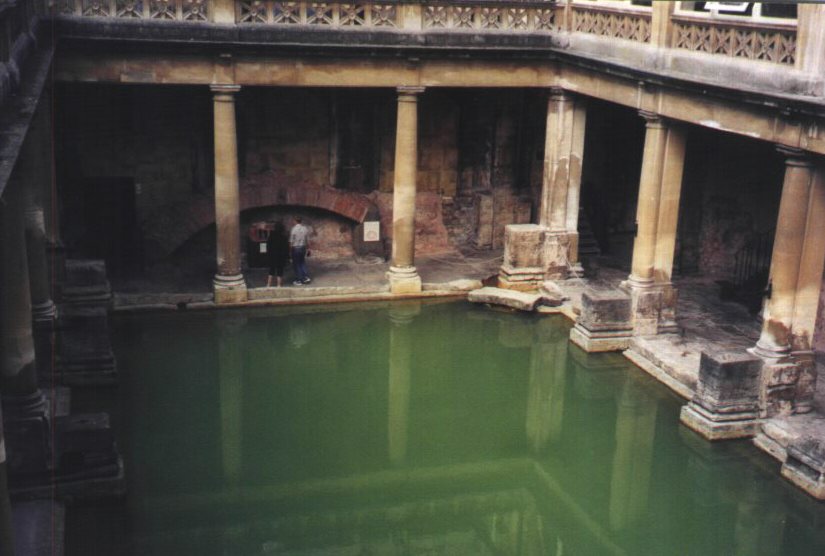
is named for the hot springs, the only hot springs in all of England. The Romans,
who occupied Bath for 400 years building extensive baths and a temple, made
Bath famous. After the Romans left, the local inhabitants stopped taking baths,
but the name remained. The Bath Abbey was built in 973 AD and Edward I was crowned
the first King of England in the Abbey. The Abbey was rebuilt again about the
year 1,500. Beautiful stained glass windows and a fan-vaulted ceiling make the
the Abbey a centerpiece of the town. The oldest standing building in town is
the Sally Lunn building, built in the 1680's. At the top of the building is
an owl hole to entice owls to nest. The owls keep down the population of mice.
Another unique aspect of the town is the Peltney Bridge, designed after the
Pont Vecchio in Venice; there are narrow shops along the sides.
Amazingly, the town was built according to a succession of master plans starting with the Romans. The tour of the Roman Baths is extensive - tepid baths, sauna, tepidarium, caldarium, and frigidarium baths. An audiotape headset provides a self-guiding ninty minute tour, giving the visitor a dialog of the layout of the Baths. Every day there is a very interesting two-hour walking tour (and the tour is free) of the town conducted by volunteers. We stopped at the local Postal Museum and learned that the first postage stamp ever used was issued on May 4, 1840 from the same building in Bath. However, Bath jumped the gun and postmarked a letter on May 2nd. Prior to the issuing of stamps, all costs were paid by the receiver of the mail. With the issuance of stamps, the sender pays and mail slots appeared in doors. Prior to this, the receiver could refuse the mail.
Bath has some neat restaurants in the basement of buildings. Along the sidewalk you look down one story to the basement level where shops or restaurants are located. The lower level is just like Seattle and result from the same problem--flooding. Downtown Bath was raised an entire story from the original Roman town because of flooding. We had a great dinner at the Wife of Bath, just around the corner and down a set of steps to the old Roman level from our hotel (B&B) Parade Park. Mushroom soup, stuffed mushrooms, peppered steak, chestnut and vegetable casserole. The night before we ate at Durmunds, a vegetarian restaurant. The meal was tasty, but not very suitable for John. Our B&B hotel is in the old part of Bath and is very close to many restaurants and sights. The town is not car friendly that is-no free parking; instead you "pay and display". Fortunately, there was a lot down the street and the overnight parking was only a pound ($0.70). We finally found out there is free parking on the other side of the river and up the hill in the neighborhood about a ten-minute walk. Of course, these small B&B/hotels are in old buildings with no lifts. Exercise and muscle building time…you drag you suitcase up the three flights. Fortunately, we travel light.
Bizarre Bath is an entertaining evening walk around the streets of Bath. A local fellow is a one-man show doing comedy, magic, and generally playing off the crowd. About 100 people gathered at the Huntsman Restaurant, paid 4.5 pounds ($6.75) and were entertained for two hours. Grand time and highly recommended! We walked as far as the Royal Crescent, consisting of thirty houses overlooking the fields above Bath, was built in an ellipse. The Circus is a set of thirty-three houses built in a circle with three entrances, that is, roads. Both sites are examples of master planning in the 18th century. Most of these beautiful houses are now split up into apartments because they are too costly to maintain as single dwelling homes. The river Avon runs through the town's lovely park, accessible for $2, with a walking path.
Stonehenge
Off to Stonehenge early this morning…This is a world famous monument
and a World Heritage Site. The park is now very protected and visitors are kept
far away from the stones. This makes for better pictures since there aren't
any people right under the stones, but you aren't as close as you would like
to be. There are complimentary audio tours that assist your tour around the
site. Stonehenge was probably built around 2,900 BC. The larger stones in the
circle are Sarsen stones, brought from the 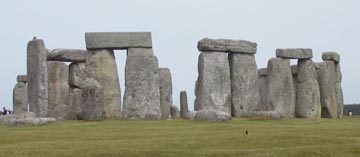 Marlborough
Downs about thirty kilometers away. The smaller stones are Bluestones and are
from the mystical Preseli Mountains in Wales 385 kilometers away. Construction
of the site is thought to be in three phases. The circular ditch and bank (henge)
around 3,050 BC; the wooden structure constructed at the center which is no
longer there was around 2,500 BC; the stone monument constructed, arranged,
and rearranged over a thousand years is dated to 2,500-1,500 BC.
Marlborough
Downs about thirty kilometers away. The smaller stones are Bluestones and are
from the mystical Preseli Mountains in Wales 385 kilometers away. Construction
of the site is thought to be in three phases. The circular ditch and bank (henge)
around 3,050 BC; the wooden structure constructed at the center which is no
longer there was around 2,500 BC; the stone monument constructed, arranged,
and rearranged over a thousand years is dated to 2,500-1,500 BC.
We arrived at Stonehenge only two days before the summer solstice (21 June). The next day we were at the laundromat and talked with a mother and her daughter who were going to Stonehenge for the solstice. They had their B&B reservations for over a month and were planning on being on site by 2-3 am. Sunrise is 4:57 am and there will be lots of people in the Stonehenge Circle. The roads were to be closed at 2 pm on the 20th and people would be allowed to enter the grounds and be around the stones starting at 10 pm until 9 am on the 21st. Today started out as a beautiful blue sky, shorts weather day. By the time the afternoon arrived, the sky was overcast and the temperature was chilly. By 7:30 pm, blue sky again. Hopefully, the sunrise will be spectacular over the heel stone and shining on the altar stone of Stonehenge as in the days of old! We later heard that there were 10,000 people gathered by sunrise (4:57 am) for the solstice and that the sun did shine on the altar. Some unanswerable questions: Why are the stones in a circle formation? What was done here? Who built the structure? What is signified? A lot of people seem to care. No one knows.
Salisbury
 Salisbury
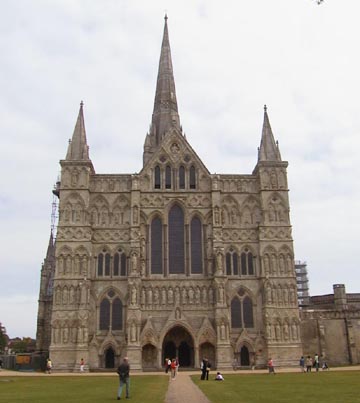
was our next stop after Stonehenge. We had a difficult time getting
to the Cathedral...we could see the steeple, but couldn't get there with the
car. Round and round the circular road and we kept getting further and further
from the Cathedral. Finally, we retraced our route and were able to park the
car and walk to the gate. The guides in the Cathedral give excellent tours lasting
about 90 minutes. Salisbury has the tallest spire, 404 feet, in the UK. The
Cathedral was built in the Early English Gothic style over a period of years
starting about 1220 AD. The main body was built first, then the tower, followed
by the spire. The Cloisters and Chapter House were built in the middle of the
13th century. The word "Cathedral" means the Bishop's "Cathedra",
which is the Greek word for chair. The Bishop's chair or throne resides in the
Cathedral.
Salisbury
was our next stop after Stonehenge. We had a difficult time getting
to the Cathedral...we could see the steeple, but couldn't get there with the
car. Round and round the circular road and we kept getting further and further
from the Cathedral. Finally, we retraced our route and were able to park the
car and walk to the gate. The guides in the Cathedral give excellent tours lasting
about 90 minutes. Salisbury has the tallest spire, 404 feet, in the UK. The
Cathedral was built in the Early English Gothic style over a period of years
starting about 1220 AD. The main body was built first, then the tower, followed
by the spire. The Cloisters and Chapter House were built in the middle of the
13th century. The word "Cathedral" means the Bishop's "Cathedra",
which is the Greek word for chair. The Bishop's chair or throne resides in the
Cathedral.
An architect was employed in the early1700's to look at the building in lieu of the Church of England beliefs at the time and suggest modernization. The man, Wyatt, reconstructed the interior of the Cathedral and removed the choir screen, moved the tombs, whitewashed the ceiling, removed the stained glass windows all to brighten up the inside and appease the reformers. The congregation was disturbed by these changes and later the ceiling was returned to the original colors. The debate continues about the other interior changes.
The church spire presses
an immense amount of weight on the tower such that the pillars were compressed.
You can look up the edge of the stone pillars and actually see the curve. To
correct the weight-bearing problem, bracing arches and internal flying buttresses
were added to support the weight. The spire has a door on the outside about
forty feet from the top. At this point in the building of the spire, the area
became so small that a person couldn't continue to build the structure. Scaffolding
was built around the outside spire enabling the completion from the outside
rather than from the inside! There are rungs on the outside to allow a person
to climb up to the top and change the light bulbs that are there to warn airplanes.
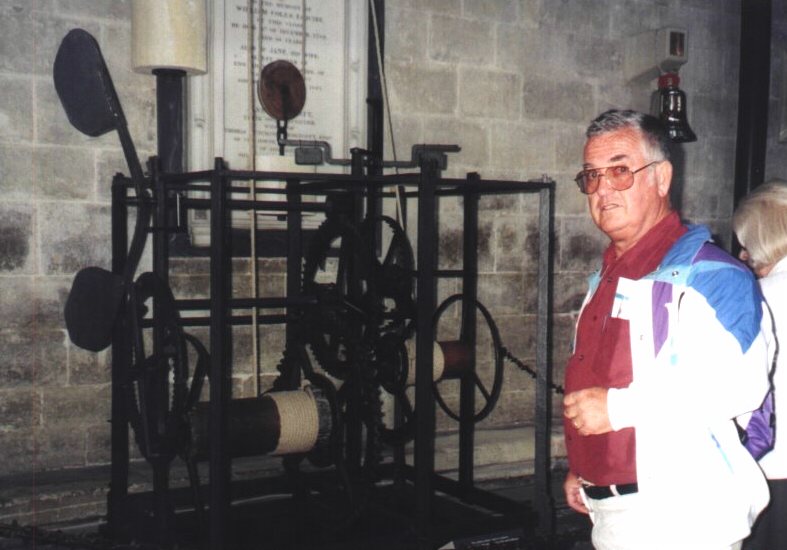
Cathedrals have Chapter Houses. They were the meeting place of the Cathedral's governing body in the medieval times. The Wells Chapter House was built in the mid 13th century. The word "Chapter" is derived from the practice of reading a chapter of the Bible at their meetings. The monks (at that time) also met to discuss and punish those monks who failed to live by the Spartan rules. The Chapter House is usually connected to the Cloisters, which were the dormitories for the monks, and can be cold, damp places. The Chapter House at the Salisbury Cathedral displays one of the four original surviving copies of the Magna Carta. The Magna Carta is the agreement made between King John and the barons at Runnymede on June 15, 1215 which declared, among the many rights, that the king was not above the law; thechurch should govern itself; all are given a fair trial; widows are not remarried against their will; and weights and measures are standardized. The charter was copied about forty times and sent to all parts of the country. This one is reputed to be the best-preserved and most legible copy, however the seal of King John has not survived. The earliest working clock in existence is in the Salisbury Cathedral. The clock was made in 1386 and originally was in Glastonbury Cathedral. The clock was originally in a bell tower and designed only to strike the hours, thus there is no clock face.
Originally the Salisbury Cathedral was about two miles south at Sarum. The Normans had fortified the area soon after their invasion in 1066. A small town grew where the Normans built a Cathedral. However, the town became too crowded and the church and military became adversaries. There was also a lack of water at the Sarum site. The Cathedral authorities under Bishop Richard Poore decided to move to a place in the meadows where five rivers met AND the Bishop owned the land. The foundation stone for the new Cathedral was laid in 1220.
 We
stopped at Old Sarum to see the view of Salisbury from the hill and to see the
site of the old palace built for King Henry I by the Bishop Roger of Old Sarum
in 1130 AD. The palace was unusual in that the building was built in two levels
with an open courtyard on the upper level. All that is left now is the archeological
excavation of the mounds and the layout of the original Cathedral. The day was
exceptionally clear and you could see quite a distance. Continuing our ride
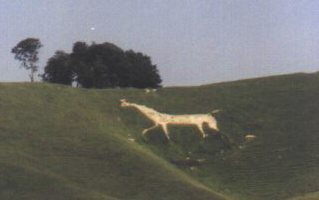
back to Bath, we saw one of the white horses.Throughout the countryside around
Avebury, Marlbrough, and Pewsey are white horses carved
into the chalk hillsides. The eleven horses were carved during the
1700-1900's and are large and visible for a quite distance. For example the
size of the Cherhill horse is 131 by 123 feet.
We
stopped at Old Sarum to see the view of Salisbury from the hill and to see the
site of the old palace built for King Henry I by the Bishop Roger of Old Sarum
in 1130 AD. The palace was unusual in that the building was built in two levels
with an open courtyard on the upper level. All that is left now is the archeological
excavation of the mounds and the layout of the original Cathedral. The day was
exceptionally clear and you could see quite a distance. Continuing our ride
back to Bath, we saw one of the white horses.Throughout the countryside around
Avebury, Marlbrough, and Pewsey are white horses carved
into the chalk hillsides. The eleven horses were carved during the
1700-1900's and are large and visible for a quite distance. For example the
size of the Cherhill horse is 131 by 123 feet.
In the town of Bath and elsewhere we noted co-op funeral services! What is the co-op part?? England has LOTS of "roundabouts" or traffic circles. Every opportunity for a left or right turn has a roundabout instead. Another feature of the English roads is speed cameras taking pictures and fining people for speeding. There are signs along the road and occasionally you see the camera. Apparently, there is no controversy in England as there is in the US about the invasion of privacy in the use of these cameras. A problem of traveling by car rather than by bus is the hedgerows that block your view of the surrounding countryside. In a bus you can see above the hedgerows. Last night we had dinner at the Bathwick Boat restaurant in Bath-- Very good lamb steak and rump steak. The restaurant was on the banks of the Avon River with a lovely balcony and a beautiful blue-sky evening.
Wells
We drove a TOTAL of about fifteen miles southwest today to Wells and decided
to stay at a lovely old B&B, Crown At Wells, located in the heart of the
town at the Market Place. Supposedly William Penn preached to a crowd from a
window at the Crown. A first class restaurant, Anton's Bistro is part of the
hotel where we had a delightful dinner of mushrooms, chicken & bacon salad,
salmon, and roast beef. We were seated beside a couple from Switzerland and
talked with them about their travels with their own car in England and Ireland.
Their car was next to ours in the car park.
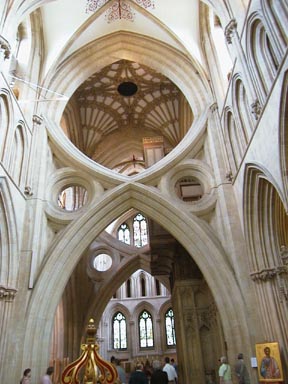 The
Wells Cathedral required three centuries to be built, from 1175-1508. This is
the first gothic style Cathedral to be built in England. In 1180 AD the construction
began. By 1230 the west front was started. During the years 1315-1322 the central
tower was built; and between 1339-1348 the scissor arches were constructed.
The magnificent West Front contains the largest gallery of medieval sculpture
in the world. The lower niches are biblical scenes, then kings, bishops and
orders of angels and on the top rows are the twelve apostles with Christ. Again,
this was done to tell a story to the peasants who could not read. The
scissor arches in the nave is the most striking feature of the Cathedral
and were built when they discovered that the tower was causing the walls to
sag. The scissors arch looks modern, but the design was a medieval solution
to the sinking tower foundation.
The
Wells Cathedral required three centuries to be built, from 1175-1508. This is
the first gothic style Cathedral to be built in England. In 1180 AD the construction
began. By 1230 the west front was started. During the years 1315-1322 the central
tower was built; and between 1339-1348 the scissor arches were constructed.
The magnificent West Front contains the largest gallery of medieval sculpture
in the world. The lower niches are biblical scenes, then kings, bishops and
orders of angels and on the top rows are the twelve apostles with Christ. Again,
this was done to tell a story to the peasants who could not read. The
scissor arches in the nave is the most striking feature of the Cathedral
and were built when they discovered that the tower was causing the walls to
sag. The scissors arch looks modern, but the design was a medieval solution
to the sinking tower foundation.
The clock of the Cathedral is the second oldest working clock, the oldest with original dials in the world and was built in 1390. The clock is wound twice a week and requires 700 turns of the wheel. The clock is unique for the face has a 24 hr dial with noon at the noon position and midnight at the 6 pm position. Another proof that time is relative. On the outer ring a large star marks the hour and on a second ring a small star marks the minutes as time changes around the dial. The third dial indicates the lunar month where a pointer in the crescent moon appears thru the hole in the central disc. The glockenspiel type characters above the clock rotate every quarter hour and one of the four horsemen figures is knocked flat. About twenty feet to the right of the clock was a figure that played the chime. When the quarter hour struck, the figure struck his heels against a chime. On the hour, the figure clanged a bell. This clock also controlled a figure outside the church performing the same tasks.
The church style is known for its narrow windows, built of limestone, and many carvings of animals and figures decorating the pillars. During the reformation, the walls were whitewashed over the pink/red coloring. The west window and choir (Quire) area is the oldest part of the cathedral with the choir chairs being 665 years old. Underneath some of the choir seats, which tilt upward, are elaborate carved misericords. Who would think to look under a chair to see magnificent carvings? The Cathedral is known as the Cathedral of St. Andrew in Wells. The Chapter House, reached by a set of well-worn steps, which curve up to the impressive room, is an octagonal room with a central pillar radiating across a vaulted ceiling.
Unique features of the Wells Cathedral are the clock, the east window, and the Chapter House. The outside front of the Cathedral, 147 feet wide, is covered with many statues. Back in the medieval days people couldn't read so the church had to relate the teachings via stories carved in stone or stories in the stain glass of in the windows. Many of these stone carvings are being refurbished.
The central tower of the
Wells Cathedral is 182 feet and the other two towers are 124 feet high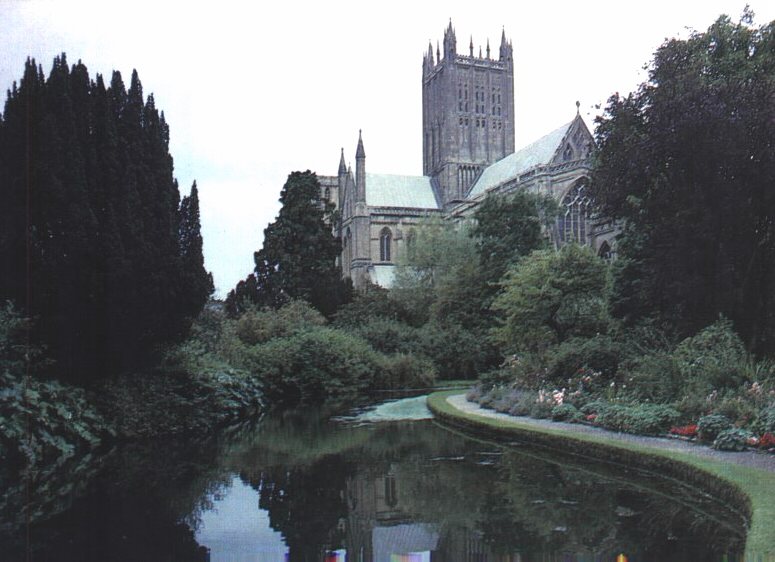 .
At 5:15 pm each evening is Evening Song, a sung service. Attendees sit in the
choir area behind the choir. We attended and thoroughly enjoyed the men's choir
(ten men). One of the tenor voices was superb! The sound fills the Cathedral,
which is perfectly acoustical. The Old Testament reading was about going up
to the top of Mt Nebo(Jordan) and the death of Moses...we visited Mt Nebo in
April.
.
At 5:15 pm each evening is Evening Song, a sung service. Attendees sit in the
choir area behind the choir. We attended and thoroughly enjoyed the men's choir
(ten men). One of the tenor voices was superb! The sound fills the Cathedral,
which is perfectly acoustical. The Old Testament reading was about going up
to the top of Mt Nebo(Jordan) and the death of Moses...we visited Mt Nebo in
April.
Outside of the Wells Cathedral is the Bishop's Palace, a large enclosed fortress, surrounded by a moat. One wonders why bishops needed such a place. The Palace was built by Bishop Jocelin in the early 13th century and added onto by Bishop Burnell at the end of the 13th century, and Bishop Beckynton in the 15th century. Currently, the wing built by Beckynton is the home and offices of the current Bishop of Bath and Wells. The wells or springs from which the city is named rise in the Palace grounds. These springs produce an average of forty gallons/second and provided all the water to the community during the 15th century. Four of the springs are in the pool behind the Palace and the reflection of the spires of the Cathedral makes for an award-winning picture.
Interesting comparisons to ancient Egypt...the crook or crosier carried by the Bishop as a sign of his calling ...is this the same as the Egyptian Pharaoh carries? In Pharaoh time the common people were always kept at a distance from the temples, only the priests were allowed in to the temple area. The same thing goes for the Cathedrals, only the priests were in the Cathedrals, the common people could sit around outside or during religious festivals along the edge but not in the central naïve..
Glastonbury
We left Wells and headed to Glastonbury, one of the oldest religious foundations
in Britain and known for the huge abbey. Now, the site is mostly a ruin having
been used as a quarry after the reformation. Another "fable" for the
pilgrim trade is that Joseph of Arimathea brought Jesus Christ, as a youth,
on a trading expedition to Glastonbury. Joseph "reputedly" returned
to Glastonbury after the crucification of Jesus and supposedly built a little
simple place of worship of interwoven willow branches and plastered 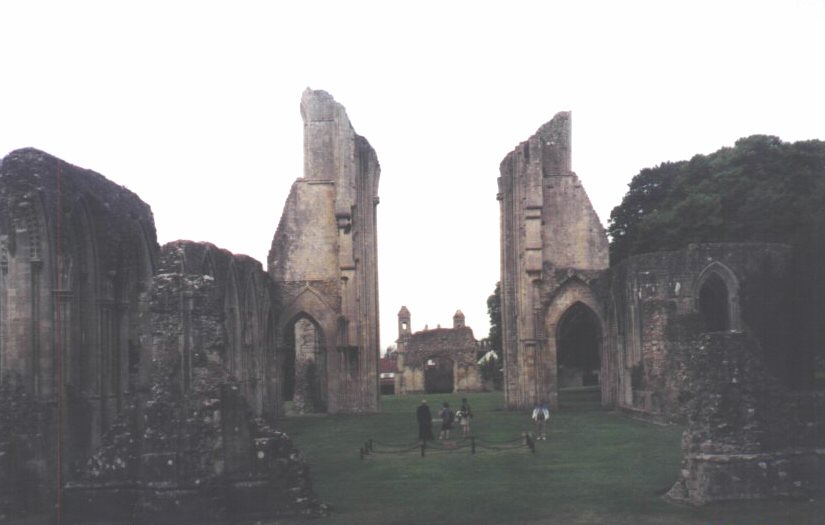 them
with mud (the wattle church) subsequently called the "Old Church"
which is the site of the Lady or St. Mary's Chapel. Therefore, Joseph is thought
to be the founder of this Abbey. The abbey length was 580 feet with the main
tower being about 217 feet high. What we see today
at Glastonbury are the remains of the church built to replace the one destroyed
by the 1184 fire. A great little museum tells about the history and
life of the Abbey.
them
with mud (the wattle church) subsequently called the "Old Church"
which is the site of the Lady or St. Mary's Chapel. Therefore, Joseph is thought
to be the founder of this Abbey. The abbey length was 580 feet with the main
tower being about 217 feet high. What we see today
at Glastonbury are the remains of the church built to replace the one destroyed
by the 1184 fire. A great little museum tells about the history and
life of the Abbey.
When Henry VIII dissolved
the Catholic Church in England, called the Disillusionment, all the Abbeys in
England, Wales, Scotland and Ireland were appropriated and the property was
sold. The Abbeys were great landowners because they needed the income to support
the monastic life. During the dissolution anything that could be stripped from
the monasteries was sold or stolen. Many people became rich and bought the Abbeys,
which were then converted into castles. The ruins of the Abbey church on the
site at Glastonbury are quite large. Other ruins include the monastery, monk's
kitchen, dormitories, and Lady Chapel. St. Patrick was here first, then went
to Ireland and returned to Glastonbury and finally was buried on the Abbey grounds.
Supposedly, or is this another fable for tourists, King Arthur's and Guinevere's
remains were found here in 1191. That really started the tourist trade in the
area. We chatted with a priest who is a "docent" on the site. He says
hourly prayers in the Celtic language. He told us that if we wanted to see the
many "missing" stones of the Abbey, all we needed to do was to walk
around town. 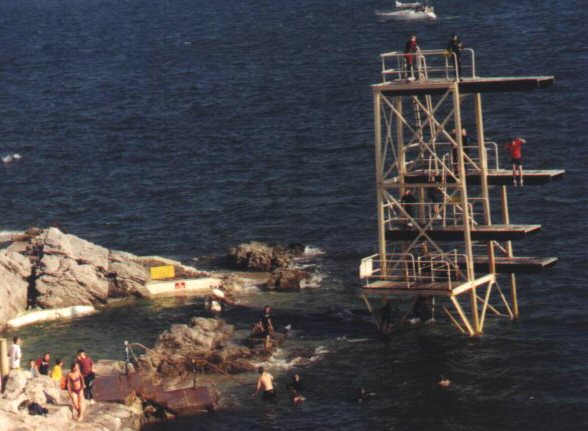
Plymouth
We left Glastonbury early on Thursday and headed for Plymouth stopping
at a city information center where we foundPlymouth was booked solid this weekend
for a Jehovah Witness's convention. However, they were able to book us into
the last room in town at the Headland Hotel,located right on the waterfront.
We checked in and then walked around the Hoe or high point. We never saw any
Witnesses and our hotel was nice and quiet. The waterfront of Plymouth is totally
for walking, relaxing and recreation. There are swimming pools along the coastline
where people were swimming - cold, but some people were in. Many
boys were diving off the high places, clothed in their wetsuits and sneakers.
They would jump off any high point. The pools need to be reconstructed
and there are signs that they are beginning to do this. We strolled along checking
out our options for tomorrow to get a harbor tour and a city tour. From the
Hoe, we watched the HMS Ocean, the largest warship in the British Navy come
into the harbor and head up the river to its berth. The Hoe is where there are
many monuments to the various wars in which Plymouth has played a vital part.
Plymouth was where most of the United States troops departed on their way to
Normandy. We had dinner on the wharf area looking out at the breakwater two
miles out from shore that took 30 years to build. Out further in the Ocean from
Plymouth is the forth version of the famous Eddystone Lighthouse. The reconstructed
third version is being restored on the Hoe.
Friday - woke up to another beautiful blue sky, shorts weather day! Off on the topless tour bus around town, then we took the harbor cruise. Plymouth is the homeport of many of the ships of the British Navy. While we were there, the Navy was having training with the EC group and ships of about five other countries are in port. The tour boat was followed up the river into the Navy Base by a Portuguese submarine! After leaving the boat, we continued our topless tour bus trip. By evening, being Friday, everyone was out sailing. Lots and lots of boats were sailing around the sound. Also, many kids were out this evening jumping off the various places around the Hoe into the water and having a grand time. The tide was extremely high. I can't believe the water is that warm, many have full wet suits, yet there are plenty of kids with just their bathing suit and t-shirts. During WW II about eighty percent of the city was destroyed. They suffered four years of bombing because Plymouth was a main port for the Navy and commercial shipping. In fact most of the US ships left Plymouth for the Normandy invasion. For dinner, we ate at the Wet Wok, Chinese, down on the waterfront.
Plymouth, England has been the last port of call for many famous ships and men. The Mayflower spent its last night here and left for what would become Plymouth, Mass.; Admiral Sir Francis Drake, who also was the mayor of the town, left here and beat the Spanish Armada and also was the first to circumnavigate the world; Sir Charles Darwin left from here on the Beagle to formulate his theory on evolution; Captain Cook left from here three times; Captain William Bligh brought Cook's ship back on the third voyage and left again from here in command of the Bounty; Sir Walter Raleigh left here to found the first European community to settle in the Carolinas; and Sir Charles Chichester, who sailed from here single-handed, around the world----to name a few. Some of Cook's officers, besides Bligh, were Whidbey and Vancouver! The survivors of the Titanic came in here at Plymouth. All of these famous people got their last provisions before setting sail on their epic voyages.
Saturday - We left Plymouth and drove west --taking the free ferry. We wanted to see the rural areas and coastline. There are a lot of small beach communities with the homes built on the hillside over the rough coast. Eventually, we tired of one-lane roads with hedgerows and headed back east and north toward Bristol with a stop at Buckland Abbey. This Abbey was a Cistercian monastery founded in 1273. In time the abbey consisted of over 2,ooo acres. When Henry VIII dissolved the Catholic Church in 1539, the building and land was sold to Sir Richard Grenville, one of Henry's cronies, who redid the building as a mansion. When Grenville drowned with over 500 men aboard the Mary Rose in 1545, his heir, another Richard Grenville, continued the refurbishment of the property. When he was lost at sea in a battle with the Spanish, the property was then sold to Sir Francis Drake in 1582 while he was mayor of Plymouth. The property remained in the Drake family until 1946 when the estate was bought and given to the National Trust. For many years under the Drake family, the working estate continued to be developed as a mansion. After a devastating fire, the building was again remodeled. The estate is now a historical trust site. While we were there, a craft and Elizabethan Fair was on the grounds.
Wales - Cardiff
We drove on to Cardiff, Wales on the high speed Motorway (M5) and arrived
there about 3 pm. Cardiff is a big city and difficult to get around at rush
hour, if you don't have any maps and the GPS was beset with "canyon effects".
We finally found the information center and were able to get a hotel in the
center of town at the Jurys. Free parking-- thank goodness. Jurys is right down
town and we can walk to the Cardiff Castle, museums, and restaurants. The town
was jumping as we arrived-- Lots of people on the streets, milling about and
shopping. The economy seems to be doing well here since we saw lots of people
carrying packages.
We walked around town checking out the time of the tour bus and the openings for the Castle, and the museum. We found the outdoor restaurant street and had dinner. The restaurant street was buzzing with lots of people having drinks, parties, etc. The style for the girls seems to be high heel sandals and shoestring strap tops with plenty of top showing. Cardiff is not as clean as cities we have seen in England. There was lots of paper and trash lying around. We finally found and Internet cafe and Juno still wasn't working, since the 16th, so I got another email address here in Wales with iemail.com who ran the Internet cafe. Today was another blue sky, shorts day!
June 14 - Cardiff is a surprisingly lovely town. The coal industry was the underpinnings of the town and the Bute family was the owner of everything having to do with the coal export business. They became exceedingly rich. However, they did share the moneys with the city and built beautiful buildings. Of course, coal exportation made this city a port and finally by 1904, Cardiff became the capital of Wales. Now, since Wales has their own Parliament that is here also. Cardiff was a large port for the export of coal and sadly now they import coal from the Eastern European countries. Captain Scot left from Cardiff on his trip to the South Pole and the shopkeepers gave him provisions and free coal for his ship.
Cardiff has lots of parking and the city is bustling on both Saturday and Sunday. New apartments are being built and the seaport area is being redeveloped into expensive and exclusive marinas. Many illegal Irish immigrants came into the Cardiff area in the 19th century. They worked in the mines and at the port. The Germans heavily bombed the port in WW II. Eventually, the area became decrepit and in need of major restoration. Lots of money has poured into redoing the docks area into apartments, cinemas, restaurants and strolling places. In the redevelopment of the docks area, a large barrage was built that closes off the river from the sea so the tide doesn't affect the newly created marinas. A large lake was formed behind the barrage with access to the sea via a lock. Many old warehouses have been redone into apartments and restaurants. Cardiff's rehabilitation has put a major emphasis on the water. They have reclaimed land and buildings around the dock area and have made the area people friendly again. They have revitalized the area with the barrage and have more plans for entertainment in the area. Someone with a lot of help has developed a great master plan and the people of the city, apparently, are involved and responding to the hope for a better future.
Brains is the largest brewery in Cardiff and we are told that SA is the beer to drink. We drank some SA that afternoon at a pub near Jurys, which is an example of architecture that was kept when many of Cardiff's buildings were being torn down. As we sat there and looked around at the neat tile architecture, we read the signs that indicated this was a gay bar by night.
 The
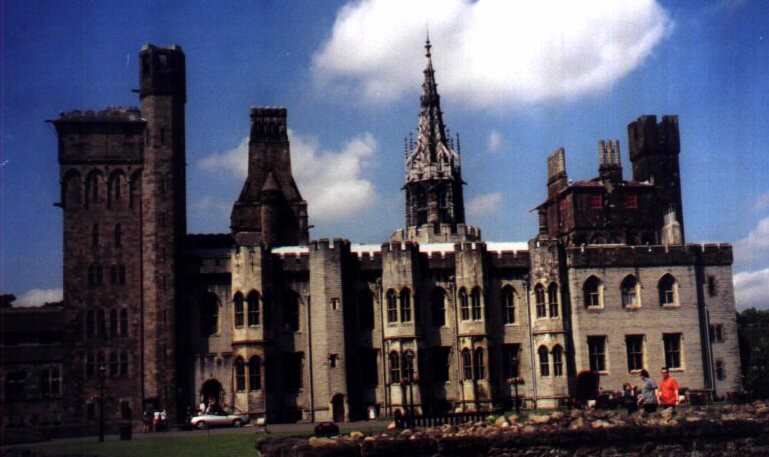
Marquess of Bute built Cardiff Castle 150 years ago over a Roman fort,
which also incorporates a Norman Keep and the 2000-year-old Roman walls. We
visited the Cardiff Castle and Fort and found that the outer walls of the original
Welsh fort followed the older Roman walls. You can see the massive Roman walls
that were built about 70 ad in a subterranean archeology site. The Second Marquess
of Bute, the money behind Cardiff from the coal, started the renovation of the
Castle. His son, John Bute, redid the castle into a medieval castle in the1860s.
In 1868, the third Marquess was considered the richest man in the world. The
winter smoking room shows the passage of time and the clock tower was very ornately
painted with the zodiac signs and scenes of people in medieval costumes. In
the nursery there is a large frieze depicting nursery stories. The stories are
painted on tile blocks and the figures are about forty inches tall. The castle
has one amazing room after another. The Arab room has a ceiling in block relief
like you are inside a cave. The ceiling is made of wood and covered with gold
leaf or painted. The walls and floor are made of twelve different marbles representing
the zodiac. The banquet hall is a large room depicting the history of the castle
and its owners with Spanish walnut paneling and a beautiful screen. Local people
may have wedding receptions here. We climbed up a circular staircase, which
was the reverse of the normal staircase, i.e. left hand spiral, to the bedroom,
which is richly decorated. Would you believe? Running water in the bathroom
in 1870. Above the bedroom is a roof top garden inspired by the courtyards of
Pompeii. The courtyard had been open to the sky, but with all the rain and the
leaks, they have put a covering over the garden. The Third Marquess was a world
traveler and a lover of animals and many carvings are scattered throughout the
castle depicting animals from around the world. Duck billed platypus, beavers,
armadillos, and howler monkeys to name a few. In the library is a large desk
like structure, which is the central heating for the room. All of the books
are now in the National Library.
The
Marquess of Bute built Cardiff Castle 150 years ago over a Roman fort,
which also incorporates a Norman Keep and the 2000-year-old Roman walls. We
visited the Cardiff Castle and Fort and found that the outer walls of the original
Welsh fort followed the older Roman walls. You can see the massive Roman walls
that were built about 70 ad in a subterranean archeology site. The Second Marquess
of Bute, the money behind Cardiff from the coal, started the renovation of the
Castle. His son, John Bute, redid the castle into a medieval castle in the1860s.
In 1868, the third Marquess was considered the richest man in the world. The
winter smoking room shows the passage of time and the clock tower was very ornately
painted with the zodiac signs and scenes of people in medieval costumes. In
the nursery there is a large frieze depicting nursery stories. The stories are
painted on tile blocks and the figures are about forty inches tall. The castle
has one amazing room after another. The Arab room has a ceiling in block relief
like you are inside a cave. The ceiling is made of wood and covered with gold
leaf or painted. The walls and floor are made of twelve different marbles representing
the zodiac. The banquet hall is a large room depicting the history of the castle
and its owners with Spanish walnut paneling and a beautiful screen. Local people
may have wedding receptions here. We climbed up a circular staircase, which
was the reverse of the normal staircase, i.e. left hand spiral, to the bedroom,
which is richly decorated. Would you believe? Running water in the bathroom
in 1870. Above the bedroom is a roof top garden inspired by the courtyards of
Pompeii. The courtyard had been open to the sky, but with all the rain and the
leaks, they have put a covering over the garden. The Third Marquess was a world
traveler and a lover of animals and many carvings are scattered throughout the
castle depicting animals from around the world. Duck billed platypus, beavers,
armadillos, and howler monkeys to name a few. In the library is a large desk
like structure, which is the central heating for the room. All of the books
are now in the National Library.
We took the city topless bus tour and found out about the riches in the city including a number of beautiful buildings. The Natural Museum is fabulous and we spent three hours there in awe. The museum has great displays, videos, and birds hanging on thin filaments. The Evolution of Wales Hall depicts the earth's formation from 700 million years ago through the age of dinosaurs and mammoths to the ice age of 10,000 years ago. Descriptions of collisions with meteors are very graphic relative to the destruction and effects on the earth's mantle plates. The videos and sounds provide a rich experience and are done in both English and Welsh. Truly, this is the best display of earth's evolution that we have seen. This museum was refurbished in 1993. The museum also has a rich display of paintings and with each painting is a description of the painter and what he/she is trying to show in the painting. By reading all the explanations, one can gain a valuable education on art. More museums should use this technique.
Wales - Swansea
On Monday, we headed to Swansea about thirty miles away. Swansea is on the Gower
Peninsula, which is well known for the beauty of the countryside. The whole
coastline has been set-aside as a Heritage Area. We drove all the way from Swansea
to Rhossilli to see the coastline and beach area. The tides here are 20-50 feet
depending on how far up the channel you go. The unfortunate part about driving
here in the UK is that the British have hedgerows and when you are in a car
you can't see a thing. If you are in a bus, you are above the hedges and can
see. So a lot of the beauty is not seen unless we stop. So we stop a lot and
look around. To fill the car with gas cost 28 GB for about 47 liters. Today
was 27 degrees C, which is about 84 F. The day is very warm. We talked to a
fellow in the hotel elevator who said they only get about 2-3 days like this
a year! Well we are here...last time they had a heat wave was when we were in
Scotland a few years ago!
On Tuesday, we will work on John's genealogy by again trying to find his Great
Grand father, Jeremiah Driscoll, who was born of Irish parents here in Wales.
We know nothing more about him, while he lived in Wales, except some US census
age data that differed at different times. John went to the Welsh Ancestor Center
in Swansea to see if he could find Jeremiah Driscoll. He got some more census
information, but no concrete info about Jeremiah's birth. We also went to three
museums today. The Tram Museum has a collection of the first electrified trams
that carried people between Swansea and Mumbles. The line was discontinued in
1960---the way of most great streetcar right-of-ways! The free Maritime and
Marine museum had an excellent display on the growth of the Swansea area due
to copper smelting and tin mining. The local coal was used for the smelting
process. The valley was the leading copper smelting in the UK and eventually
imported copper from around the world. The docks were massive to handle the
importing of raw material and exporting of the finished metals. The toxic air
and runoffs in the land caused the hillsides to become barren and nothing would
grow because of the toxicity. Finally, the copper and tin industries died out
and Swansea began to realize what had happened to their environment and took
steps to rectify the problem. Today, the area is green and they have redeveloped
their docks area with housing and recreation. We visited the Swansea Industrial
Museum housed in a Greek style building that had been damaged in WW II. They
have a mummy of Hor, a priest from a temple north of Luxor. The museum acquired
the mummy via Grenfeld, an army officer stationed in Egypt who had an interest
in Egyptology. He used his soldiers to excavate and was able to bring back personal
artifacts. The museum restored the mummy and the body is now suspended above
its wooden coffin in a controlled environment. When we were complementing the
guards on the mummy, they told us not to miss the Egypt Center. We asked, "What
is that?" and they told us about what was to be a high point in Wales.
The University of Swansea campus outside of downtown Swansea houses the Egypt Center. The building is a good little museum focusing on the Egyptian funerals, gods, and the ancient life. We chatted with one of the curators/professors about the date of the building of the Sphinx and how we disagreed with the Egyptologist and that our recent trip to Egypt verified our opinion. He said, "Most experts are now accepting the fact that the Sphinx was built much earlier since there is uncontestable geological proof. We talked to him about the Amarna Letters and he pointed out their exceptional exhibit on the few findings they have from Amarna. The University was able to get a number of crates of the Wellcome treasures from Egypt which otherwise was totally taken by the British Museum. Since the treasures had never been catalogued, the University lucked out and got, among a lot of other treasures, three beautiful beaded collars found in the graves of Akhenaten's daughters. The thread is thought to be original. The central carved amulet is rare and shows the god Bes as a female. The other collar has exquisitely carved amulets of Bes, fish and baboons. They also have a fragment of a throwing stick with the cartouche of Akhenaten, the so-called heretic Pharaoh. We have, subsequently, exchanged several emails with our contact at the University. The museum also has a neat school program where they show the kids about mummification. They have a four-foot doll that has a zipper in the side for the extraction of the internal organs for separate burial rites. The students use an embroidery hook to twist around in the nasal cavity and extract pieces of yarn simulating removal of the brains, which the Egyptians thought were not worth saving! The Egyptians thought the heart was the most important body part.
Pub grub is the typical style of eating these days. Food is simple and inexpensive. They have baked potatoes with all kinds of toppings such as tuna salad and corn, fish and chips, lamb steak, and various meats such as roasts with chips and peas. John's gummy bears melted in the hot car on Monday. Now, he bites off a chunk at a time.
We visited the National Botanical Gardens located northwest of Swansea near Carmarthen. This is a beautiful garden complex with a large glass house that houses Mediterranean type gardens representative of California, Chile, West Australia, North Africa, South Africa and Europe. The huge glass dome is the largest in the world at 99 m x 55 m. The southwest Cape of Africa is the richest in terms of the number of floral species in a given area. One out of six plant floral kingdoms in the world come from this part of Africa. Inside the glass house, 3,560 square meters in area, the gardens are planted in stonework with a Mediterranean climate. Rainwater is captured from the glass roof. There is a ravine five meters deep in the garden, which is designed to be as naturalistic as possible. Katherine Gustafson, an American, designed the glass house. The entranceway to the garden has a lazy ten-inch wide lined stone sluss, which flows, from the fountain at the top of the hill to the ammonite shell like pond at the bottom. Lots of people, mostly older than us, were there on a weekday even though the garden is in the rural area.
We drove on the A40 through
the Brecon National Park and down into the town of Merthyr Tydfil, the iron
capital of the world in the 1800's. 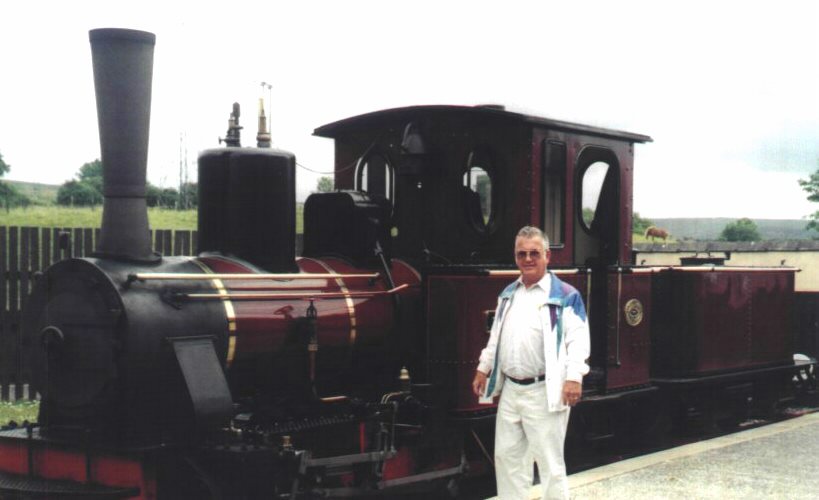 The
town has an old mountain railway, Brecon Mountain Railway, that runs several
miles from Mrthyr Tydfil to Pontsticill. The town had the greatest
iron works in the world with the first furnaces as early as 1765. Much of the
growth of Cardiff, Swansea, and Newport was due to the industrialization in
the Merthyr area. The population was 90,000 in 1802 mostly engaged in the production
of pig iron. When steel became big, they tried to get into the steel mill business,
but were unsuccessful. Pittsburgh, Pennsylvania with new steel technology methods
won the competition. Under the guidance of the Crawshay family, the town prospered,
however, Crawshay was not a benevolent employer. Labor was cheap and a men were
expendable. When the coal industry went south because the steel industry started
to fail, we were told that many people of Irish ancestry moved from the Merthyr
area to Scranton, PA. We used the tourist information enter once again and secured
a lovely B&B at the Chaplins.
The owners, Peter and Elaine, have a lovely pub and B&B in the center of
town. Charlie Chaplin was a favorite comedian of Peter and Elaine. We visited
the Cyfarfhfa Castle built by the Crawshay family. The Castle overlooks the
town. The Castle also had some neat Egyptian artifacts. We wondered if the university
folk back in Swansea knew about this place. Probably not-we are about 50 miles
from there.
The
town has an old mountain railway, Brecon Mountain Railway, that runs several
miles from Mrthyr Tydfil to Pontsticill. The town had the greatest
iron works in the world with the first furnaces as early as 1765. Much of the
growth of Cardiff, Swansea, and Newport was due to the industrialization in
the Merthyr area. The population was 90,000 in 1802 mostly engaged in the production
of pig iron. When steel became big, they tried to get into the steel mill business,
but were unsuccessful. Pittsburgh, Pennsylvania with new steel technology methods
won the competition. Under the guidance of the Crawshay family, the town prospered,
however, Crawshay was not a benevolent employer. Labor was cheap and a men were
expendable. When the coal industry went south because the steel industry started
to fail, we were told that many people of Irish ancestry moved from the Merthyr
area to Scranton, PA. We used the tourist information enter once again and secured
a lovely B&B at the Chaplins.
The owners, Peter and Elaine, have a lovely pub and B&B in the center of
town. Charlie Chaplin was a favorite comedian of Peter and Elaine. We visited
the Cyfarfhfa Castle built by the Crawshay family. The Castle overlooks the
town. The Castle also had some neat Egyptian artifacts. We wondered if the university
folk back in Swansea knew about this place. Probably not-we are about 50 miles
from there.
We returned briefly to Cardiff the next morning to talk with the priest at St. David's church to see if he could provide any information on Jeremiah Driscoll. In Swansea, the Wales census records indicated that in 1851 a Jeremiah Driscoll, age 9, lived on John street just around the corner from the church in Cardiff with his family. The priest promised to see if the Baptism records survived the destruction of the church by the Germans in WW II.
Windsor
We drove straight east to Windsor via the M4 and had a problem finding
a B&B. The tourist information place closed five minutes before we finally
found the sign. We finally resorted to knocking on B&B doors that had no
vacancy signs to get a referral. After about 15 minutes of searching, we got
the last available place at a very nice B&B only four blocks from the Castle
that even had a car park. We signed on for the three nights that we had left
for the trip. Prices are high in Windsor notably because this is the home of
the Windsor Castle. We walked around town, had dinner where Rick Steves told
us to go for the view of the Castle. Fine meal-no view. As we walked down the
street after dinner, on the spur of the minute, we got instant tickets and saw
the play "Hay Fever" by Noel Coward at the Theater Royal. We had seen
this play at our Olney Theater several years ago, but it was interesting to
see how the English staged the play.
 We
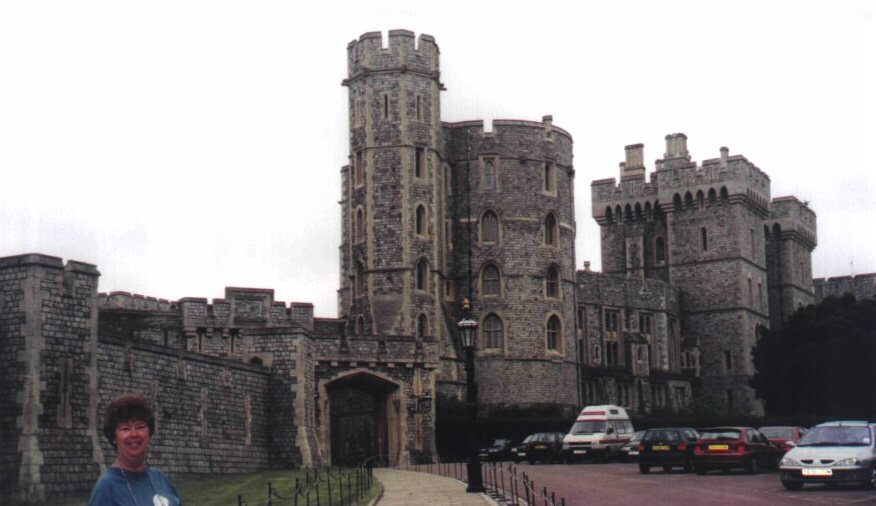
toured Windsor Castle the next morning and
found out that the Queen was in residence. We hoped we would see her coming
around the corner or inviting us up to tea, but alas, we didn't and she didn't.
Windsor Castle is the longest used castle as a living place, over 900 years.
William the Conqueror built Windsor in 1080. By 1184, Henry II had transformed
the Castle into one of the most powerful strongholds in England. Henry II added
to the Castle specifically for living purposes. Edward III transformed the Castle
to a Gothic palace and the place essentially remained unchanged for the next
300 years. Edward IV added St. Georges Chapel, which is as large as some Cathedrals,
in 1475. Construction took 50 years and finally Henry VIII finished the structure.
Windsor Castle became a military headquarters in 1642 during the civil war.
We
toured Windsor Castle the next morning and
found out that the Queen was in residence. We hoped we would see her coming
around the corner or inviting us up to tea, but alas, we didn't and she didn't.
Windsor Castle is the longest used castle as a living place, over 900 years.
William the Conqueror built Windsor in 1080. By 1184, Henry II had transformed
the Castle into one of the most powerful strongholds in England. Henry II added
to the Castle specifically for living purposes. Edward III transformed the Castle
to a Gothic palace and the place essentially remained unchanged for the next
300 years. Edward IV added St. Georges Chapel, which is as large as some Cathedrals,
in 1475. Construction took 50 years and finally Henry VIII finished the structure.
Windsor Castle became a military headquarters in 1642 during the civil war.
Charles II remodeled the Castle and George III rebuilt the exterior. George IV was responsible for the largest reconstruction. On Nov 20, 1992 at 11 am a fire broke out in the private chapel of the queen and did extensive damage. Over 1/5 of the Castle was affected, 105 room were damaged and nine major staterooms were destroyed. Fortunately, there was redecoration going on in the St. Georges Hall and the Hall was empty of valuable paintings. However, the adjacent rooms had to be quickly evacuated. One of the guards told us he was there that day and the workmen for the redecoration had a portable scaffold and they were able to remove the paintings and other artifacts. Amazing only three paintings were lost. In the reconstruction of Windsor many prior building techniques and artifacts were discovered. Five of the nine state rooms were restored to their original state and the other four were modified. A large malachite vase, like another we saw in the Hermitage, was in pieces and put back together. Tsar Nicholas I had given the vase to Queen Victoria. All was completed by Nov 20, 1997. Touring through Windsor Castle today one would never know there was a fire.
We saw the beautiful Queen Mary dollhouse that is built on the scale of 1:12. This dollhouse and all its working interior and furnishings were given to Queen Mary as a birthday present. The house measures about 12 x 8 x 8 feet and the bottom layer has a pull out Victorian garden and parking areas. The Royal Library has 600 drawings by Leonardo da Vinci.
We took a two-hour boat cruise that afternoon up the Thames and through the Boveney locks. There are a lot of small, nicely appointed barges on the river being used like RVs. We also took the Windsor City bus tour, which included Eton. Eton College is a private boys school for boys age 13-18. Henry VI founded the school in 1440 for poor boys and then there was no cost. Now, the tuition is about 18,000 GB/yr and enrolment is about 1,300 boys. Most of the teachers are male. Sports are very important and crew is a big activity with a crew boat for every boy. The uniform for the school is formal morning attire that is long tails. Today was a cloudy day and a little on the chilly side. After our bus tour, we were just in time to attend the Evening Song at St. George's Chapel, Windsor Castle. We never expected to be receiving communion (evening song was a sung Eucharist) at Windsor Palace! We had a delicious dinner of lamb on rosemary-mashed potatoes, salmon on zucchini slices with lime slices and garlic fried potatoes at the Bell and Dragon.
Friday, the 29th of June was our last day to sightsee in the London area. We chose to set off eastward in our loyal Fiat steed toward Greenwich via the M4 to the "inner beltway" and around the southern part of London. The first 20 miles of this route was what we took the following day to Heathrow Airport. Two hours latter, because of heavy urban traffic, we got to our destination. The GPS was especially useful because the inner beltway is not a limited access thruway. The route uses the urban streets of the communities surrounding London. Big trucks, busses and regular old traffic and construction combined to take the fun out of traveling, but what we found in Greenwich made up for the traffic problems. The observatory buildings have been completely reinvented since we were there twenty years ago. The curators have done a great job of telling the story of William Henry Harrison and the various Astronomer Royals.
The displays about the problem of measuring accurate longitude to determine the east-west position at sea relative to the Prime Meridian are balanced with pictures of British ships getting lost and floundering on the rocky coast. The creation of the Board of Longitude, the prize money and the bureaucratic harassments of Harrison are well and truly documented. The navigational positioning problem was really an accurate measurement of time problem. William Henry Harrison was a cabinetmaker that accepted the challenge of the Board of Longitude for a solution. The rest, as they say, is history. Harrison's clocks are nicely displayed with excellent explanations of the differences between the different models. His invention of the bimetallic element for temperature compensation and his invention of the escapement mechanism to provide synchronized periods of time from a spring are fully explained. All of the models have been restored to operate.
The historical differences of the three different "zero" Meridian lines on the ground at Greenwich are noted. The differences are a result of the increasing knowledge of the earth's motions through space. This knowledge was fully documented by the various Astronomer Royals who lived in the restored house on the top of the hill. Their telescopes have somehow survived and that part of the museum is part of the Visitor's Center. As part of the renovation, several of the displays noted the Global Positioning System as the latest method of navigating and getting accurate time. In fact, there is a working atomic clock on display and a discussion on cesium fountain atomic clocks.
There is no mention of the Forth Meridian line at Greenwich because "they" did not want to detract from their "Millennium" message about where the Millennium started. The Brits were quite forgetful about the fact that the Millennium truly started in the Pacific Ocean, 180 degrees of longitude from Greenwich. The management of the Greenwich Observatory is no longer by the British Navy. The facility was downsized several years ago and is managed by Cambridge University. The University chose to go along with the mistake and hype about the Millennium and celebrated the event on 31 December 1999. They "forgot" that there was no year zero. The zero Meridian Line for the world's standard GPS-84 grid is about 400 feet east of the tourist Meridian. The line almost passes through intersection of two paved paths. I used the Garmin etrex Vista with differential correction from the EGNOS satellite with a computed error of eight feet to determine the current Meridian. Like time itself, the True Meridian is only a matter of definition. The sad thing is that history has stopped at Greenwich since the British Navy left. The good news is that there is now a great exhibit for Harrison's monumental effort. Many people forget that without people like Harrison and the Astronomer Royals, explorers like Cook and Drake would not have been historical figures.
We walked down the hill
and checked our car to see about the enforcement in the not-to-exceed two-hour
parking space and decided to move the car to an adjoining spot. The Naval Museum
had also been restored and rebuilt in the past twenty years. A roof had been
built between two wings and many new exhibits had been built for the Millennium.
The exhibit on the exploration of Antarctica was well documented and noted the
conflict of the British Navy relative to exploration and WW I. Many excellent
ship models complemented the text of the exhibits. Two hours latter and with
tired feet, we got back to our car.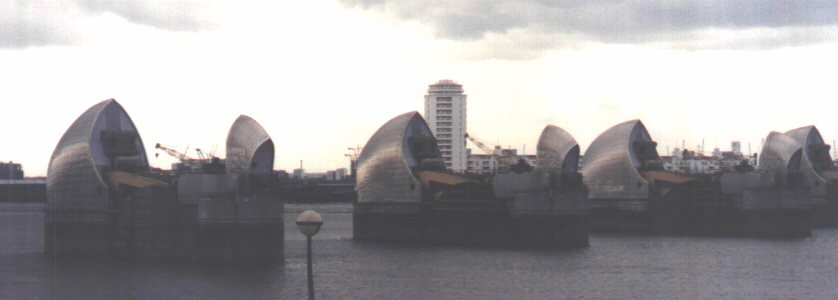
Our next and last stop for the day was just down river from Greenwich. The problem was that tidal surges threatened downtown London.So the British built the Thames River Barrier. The Barrier consists of six huge half cylinders that can rotate. When the tide is "only" a nominal twenty-five feet, the Barrier across the Thames is rotated so that ships can pass over the half cylinder. When the tide could be destructive, the cylinders are rotated to form a barrier across the river. This is quite an engineering feat. Unfortunately the visitor's center was closed, so we had a look-see at the Barrier and started back to Windsor. On the return trip we figured the drive would be easier if we went east toward Dover on the A207 and then caught the M25 west to the M4 and on to Windsor. This was a longer route back to the B&B, but there was much less urban traffic. Our good weather held out one more day. We had heard that there was rain forecast for most of England the following day. Our last dinner was fish and chips at the Victoria Hotel across from Windsor Castle.
Up and out by eight am
to get to Heathrow and turn in the rental car after over 1,200 miles of traveling
through Southern England and Wales. Our Virgin Atlantic Boeing 747 left on time
with a cloud cover over England as soon as the wheels were in the well. The
next land we saw was northern Canada eight hours latter. Great flight, great
food and service, so we will fly with Virgin again. Arrival was as scheduled
at Dulles, but our two small bags were almost last off of the plane. We had
checked them because we misunderstood the not to exceed limitation for carry
on baggage. The shuttle was waiting and an hour later we were home. Lots of
mail. The garden was overrun, otherwise things were shipshape.
Postscript
On this trip through Southern England and Wales we used ATM machines to
get British pounds. We, therefore, returned home with $1,000 in unused travel
checks. The travel checks were good insurance as we found several places where
the ATM was broken, but we found others nearby. In the future, we will cut back
on the quantity, but some travel checks are still a good backup. We did not
need much cash in the five other countries we visited for the first part of
this month long trip. The little foreign currency that we needed for shore excursions
on our own, we converted US $20 on the ship. VISA was the card of choice for
the ship and most meals. We never used the business AmEX card that John keeps
for emergencies. Our best exchange rate, at $0.70 per British pound was with
the ATM and the VISA charges. The few times we converted US cash was the worst
exchange rate at $0.63 per pound.
The GPS and its mapping system were a definite asset both in the Baltic and especially for touring around southern England and Wales. The Palm Pilot was also very useful in composing this trip report from memory, scribbled notes and tourist literature. The Palm Pilot was also useful in maintaining and changing as we go our master schedule. The fold up keyboard is readily useful while traveling.
Grand Trip! John
& Carolyn McHale
Date: 7/19/01