 Scandinavian
Capitals
Scandinavian
Capitals
Cruise through the Baltic Sea
June 2-17, 2001
This month
long trip would take us to the Scandinavian Capitols surrounding the Baltic
Sea and then on a driving tour of Southern England and
Wales. But first we had to get to the UK to tour London before boarding
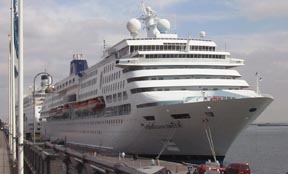
the Norwegian Line's Cruise ship, Dream,
in Dover as part of our Grand Circle Tour. Flying straight through from Dulles
to London on Virgin Airways, we arrived mid morning June third. By the time
we assembled our Grand Circle group and were transported to our hotel, we
were ready for a very short nap. Fortunately, we were able to get our room
after a little confusion on "who is going where" by the hotel staff.
The Tower Thistle Hotel is a grand new hotel located along the River Thames
beside the Tower of London and just alongside the Tower Bridge.
By one o'clock, we had
our short nap and lunch and were ready to explore London once again after a
twenty-year hiatus. We walked the short distance to the Underground (Metro)
stop, Tower Hill, and headed for the London Zoo near Reagents Park. We transferred
to a topless bus where a friendly native couple gave us directions to the Zoo
and suggested we walk through the park and enjoy the flowers on the way. They
said that there was a lovely rose garden all set to burst forth in blooms. Great
suggestion! The gardens were full of people enjoying a blue-sky day. The London
Zoo doesn't reciprocate with the National Zoo, so we needed to pay the 10 GBM
($15). This is an old zoo, of course, but has adapted their old habitats into
level 2 with a lot of enrichment for the animals. The lions and leopards are
in open areas with windowed or unobstructed views. The Lowland Gorillas, chimps,
red-faced black spider monkeys, and white-faced gibbons are in wire cages with
wood chips and lots of ropes and platforms for moving around. The zoo has a
rotating feeding schedule so the visitor can see and hear about the animals.
Because of the closing
time for the next adventure, we left the zoo via cab for the British Museum
to see some of the Egyptian antiquities. The Museum's inner court area has been
completely modernized with a beautiful glass dome over the center of the building
providing lots of light. We zipped right over to the Egyptian section. Here
we again saw the original Rosetta Stone having seen a copy in the Egyptian Museum
in Cairo only a month previously. Jet lag caught up to us half way through the
mummy section and closing time was approaching, so we left the museum and returned
to the hotel for a longer nap. Getting back to the hotel took us longer than
we thought since we didn't understand the intersection of the circle line with
the line we were on and didn't want to exit the system. Finally, about 45 minutes
later, we got back to the hotel. The game is called "Ring around the Rosy
using the Underground".
The alarm woke us up at
seven o'clock, so we went out to find dinner. Grand Circle only provided our
breakfast for the two nights in London. We walked around the St. Katherine's
dock area that surrounds the hotel and had a choice of several restaurants.
We had a mixed fish grille and fish and chips at the Dickens Inn. Early to bed
to get our bodies switched over to London time.
Our morning bus tour with
Grand Circle, color coded to separate the four buses, stopped at most of the
major London tourist attractions such as the Kensington Palace, Big Ben, Westminster
Abbey, St. Paul's Cathedral, and Prince Albert monument. Located along the banks
of the Thames, we saw an Egyptian obelisk taken from Karnack, which was "given"
to England as a gift. The mate to this obelisk is in New York. We saw the mounting
base for the obelisks just a month before in Egypt. We left the tour near its
end in center city and headed to the Family Records Center (FRC) for John to
see if he could find the birth records of his Great Grandfather, Jeremiah Driscoll.
No luck after several hours in a very nice and friendly FRC. We did find several
Jeremiah's, some who spelled their last name as Driscol and attended the Church
of England.. But, no Jeremiah's who was born in Wales in the five year time
period on either side of when GGF Jeremiah said he was born. We found a marriage
record of a Jeremiah who could be the father in 1843 and the birth records of
another Jeremiah who was born in England. We ordered copies of these records
to be sent home just to get an idea of the format of the original records. A
little dejected, we headed back "downtown" and toured the Cabinet
War Rooms Museum located in the basement of 1930 era government buildings next
to Parliament. These rooms, former storage areas modified with reinforced ceilings
to protect against bombs, were used starting Oct 15, 1940 until the end of the
war. Until a few years ago, the existence of the rooms was top secret. They
were sealed up at the end of World War II. The UK Cabinet and staff just tidied
up their desks and left. Now, the original furnishings have been found and the
rooms have been restored to the day when the war in Europe was over. A self
guided audio system provided a running commentary of the facility. Churchill
and all the major British players in the management and decision making of the
war met and for the most part lived in these rooms for almost five years. A
downer for the Brits is noted in the last display in the museum. Just when Churchill
was celebrating Victory in Europe and Before Victory in Japan was achieved,
they voted him out of office. What a way to thank him for saving the British
bacon.
Instead of taking the underground
or bus back to the hotel, we opted to take the Thames boat from the Embankment
near Big Ben to Tower Hill. Lovely ride, 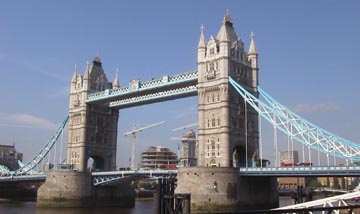 seeing
areas that are otherwise blocked by the trees, such as the replica of the Globe
Theater with its thatch roof and the millennium Ferris wheel. For the evening's
entertainment, we were very fortunate in acquiring tickets to see the Mousetrap.
This play, at St. Martin's Theater, has been running for 49 years!! The murder
mystery is quite a delightful story with an unexpected ending! No-- we can't
tell you who the murderer is! Would you believe? We had pizza for a quick dinner
in order to "Get us to the show on time."
seeing
areas that are otherwise blocked by the trees, such as the replica of the Globe
Theater with its thatch roof and the millennium Ferris wheel. For the evening's
entertainment, we were very fortunate in acquiring tickets to see the Mousetrap.
This play, at St. Martin's Theater, has been running for 49 years!! The murder
mystery is quite a delightful story with an unexpected ending! No-- we can't
tell you who the murderer is! Would you believe? We had pizza for a quick dinner
in order to "Get us to the show on time."
The next morning, Tuesday,
we were out exploring again. We walked across Tower
Bridge and explored the refurbished old docks to the East of the
hotel. A marina has been built and the old warehouses have been converted into
plush townhouses. That afternoon, an hour and a half bus ride took us to Dover
where we boarded our home for the next 12 days, the Dream. The Kiel Canal, Berlin,
Germany; St. Petersburg, Russia; Tallinn,
Estonia; Helsinki, Finland; Stockholm,
Sweden; and Copenhagen, Denmark were going to be our
next ports of call. After the mandatory lifeboat drill, as we sailed out of
the Dover harbor, we headed into the North Sea on our way to the Kiel Canal.
A British couple in our lifeboat group got a telephone call on their cell phone
from their son on top of the Dover cliff in the middle of the drill. The couple's
home was just over the hill from Dover and this was their first big trip. The
rest of the afternoon and evening was spent exploring this lovely ship in order
to determine which of the eight restaurants was "worthy" of our presence
for dinner. All of them were "visited" during the next 12 days. Some
-several times.
The Kiel Canal
After a very smooth overnight trip "north" through the North
Sea, we arrived about 11:30 the next morning (Wednesday) and entered the Brunsbutell
Locks about 12:30 pm. The canal is 62 miles long, 338 feet wide and 36 feet
deep and is considered the world's busiest waterway with approximately 50,000
ships per year and in addition 25,000 private yachts. The Kiel Canal is an international
waterway by treaty, located in Germany. The canal is also known as the North
Sea-Baltic Sea Canal and runs through flat fertile farmland. The canal was built
between 1887 and 1895 initially to serve the German military needs for a quick
way to the North Sea. The tides at the North Sea end of the canal are 15 to
20 feet while the Baltic Sea tides are only one to two feet. Locks on both ends
of the canal maintain a constant level for the canal traffic. This section of
Germany borders Denmark. We have nine bridges to sail under and the Dream was
built with a "foldable" funnel in order to clear the bridges by inches.
She is the largest ship to transit the canal and this is a sight to see from
the shoreline. While in the entrance lock, the ship folded its funnel. Hundreds
of bystanders waved to us as a German Ompa band boarded the ship. Since motoring
is so slow, about six knots, we took all day to traverse the canal. All along
the waterway, many people were out waving to the ship, which passes through
every two week during the cruise season. The day started out cloudy and sprinkled
between 11:30 -12:30 after which we enjoyed a lovely warm day. Lots of deck
time in shorts.
Berlin
On Thursday, we toured Berlin. We were up at 6:15 am, leaving at 7 am for
a 2.5 hours train ride into the city. We docked that morning in Warnemunde,
Germany where our train waited about a block away. Disembarking from the ship
and embarking the train was done with German precision. The entire trip on the
train was through the former East Berlin. While East Berlin and East Germany
was under Russian occupation very little was done to repair the war damage that
is still evident in the walls of the buildings. Former prison camps were still
evident along the railroad. Since being reunited with West Germany, all the
museums and public buildings in East Berlin are being renovated.
Berlin among other things
is known for "The Wall". On August 13, 1961, the Russian part of the
city was closed to all "foreigners" and work began on the Wall on
August 15th. In 1966-67 the Wall was replaced with a second-generation Wall
that was less penetrable. In 1972, a third generation Wall replaced the earlier
Wall and finally in 1982 the last Wall was constructed. Each section of the
final Wall was 13 feet high (height determined by pole vaulting capability),
three feet wide base, and three inches thick at the top. A large pipe like structure
covered the top of the wall so as to make the Wall more difficult to scale.
Ironically, West Germany and US companies sold products to East Germany to build
several generations of the Wall! As we all remember, on November 10, 1989, the
Wall came down! We were in the Caribbean and were told about the celibration
by a German couple. The Brandenburg Gate is the only remaining gate of the 14
gates in the Wall that once surrounded Berlin in the 16th-19th centuries. The
gate is now being restored and in most places the Wall is GONE. Not a trace!!
The history of the Wall is probably one of the greatest examples of irrationality
and waste of manpower known to man. The heroic efforts of people to achieve
freedom is diametrically opposed to those seeking communalism or dictatorship
of either the Soviet Union or the Reich.
We visited Checkpoint Charlie
where all diplomatic, political, and military persons of the occupying countries
crossed. Just beside the checkpoint is a museum about the Berlin Wall. The museum
was very crowded and, unfortunately, we only had time for a brief overview of
the exhibits. Tourists from all over the world were present noting the many
different ways that the East Germans used to escape. The next time we go to
Berlin we need more time at this museum. Our tour was a brief overview of the
city. Enough to acclimatize us to realize we need to go back for at least five
days.
Berlin now has fifteen
orchestras, three square miles of park in the center of the city (zoo is located
here), and has about 190 different ethnic groups. Since reunification, there
are still problems with equality; for example, East Berliners are paid less
for the same job. Unemployment in Germany is about 9%, in West Berlin about
8.5% but in East Berlin unemployment is 21%. Berlin has a high water table and
must pump water out of the lower areas. Consequently, you see large (three foot
diameter) pipes above ground. In one of the main squares, Gendarmen, bordered
by Humbolt University and St. Hedgwick's Cathedral, is the location where the
book burning occurred. Any books of relevance or what the communist government
didn't want in circulation were gathered and burned in this square. In the middle
of the square covered by a glass plate on the ground is a room below ground
that contains empty bookshelves which stands as a memorial to the burning of
the books. Does this not remind you of what happened to the Mayan civilization?
On both trips by train and totally by chance, we sat with newfound friends,
Bernie and Eileen from north of London. They were to be our dinner "mates"
of choice for several evenings aboard ship. Maybe because they have a "caravan"
and we have an "RV" there was a mutual attraction?? Who knows?
Tallinn,
Estonia
On Saturday, we awoke to a rainy morning as the ship docked. We headed
out at 8 am for the all day Best of Tallinn Tour. Most of the tour was on the
bus. However, we did walk through the old town. Tallinn is a very old city with
the appearance of its name in historical documents as early as 1154 AD when
the Arab, Al-Idrisi, marked a chart of the then known parts of the world. Tallinn
is located on the Gulf of Finland just 52 miles from Helsinki and 232 from St.
Petersburg. The name, Tallinn, means Danish Castle and the city has had several
names over the years such as Reval and Revele.
Estonia has had its problems
remaining free. Tallinn is situated on trade
routes, which is the reason for its location. Early history Estonia was inhabited
by the Finnish. From the end of the 12th century the Teutonic Knights and Scandinavian
nobles tried to conquer the area so they could convert the tribes to Christianity.
In the 1219 battle between the Danes and Estonians, the Danes won, but they
soon sold the northern part of Estonia to the Germans who remained in control
for over 700 years. In the 1558 war, the northern part of Estonia became free
while the southern part became part of Poland. Where was Lithuania? Sweden conquered
Estonia and education and legal systems were started. Finally about 1700, the
Swedish domination ended with the Great Northern War that lasted for 21 years.
They only fought a half-year per year because of the cold. The Russians took
over in 1721. Estonia was then freed in 1919 and remained free until the Second
World War when the country was once again dominated by the Soviets until 1991.
Estonia has been busy shaking the last remnants of the Soviet rule by rebuilding,
painting, and developing a new economy. The Soviets burned all the books, exported
60,000 educated people to Siberia, and outlawed religious services. The current
problem is that several generations of ethnic Russians feel that Estonia is
home.
 There
are 48 universities in Estonia, four of which are government sponsored with
free tuition. The year 1632 is the founding date of the oldest university. There
are 1.5 million people in Estonia, 900,000 of which are Estonian the rest are
Russian or other Slavic workers. Estonia has a small military and all 18 year
old males are required to be in the armed forces for 9-12 months. The Navy has
four ships and the Air Force has two airplanes! Tourism and lumbering are the
main stays of the economy. The Catherine Valley Park, named for Catherine of
Russia, is the largest green park in the country. Music plays a great part in
the life of the Estonians and Songfest Park is the site of a musical festival
every five years. In 1989 over 300,000 people started singing for freedom. Shortly
thereafter, on August 23rd, 2.5 million people held hands across Estonia, Lativa,
and Lithuania (600 KM). Freedom came without a drop of blood being spilt! Estonia
was the last of these occupied countries to get rid of the Russian soldiers.
Many of them did not want to leave. As we were to find in a few days, the difference
in future expectations between Estonians and Russians continues to diverge.
Maybe the Estonians have the corner on the flower market?
There
are 48 universities in Estonia, four of which are government sponsored with
free tuition. The year 1632 is the founding date of the oldest university. There
are 1.5 million people in Estonia, 900,000 of which are Estonian the rest are
Russian or other Slavic workers. Estonia has a small military and all 18 year
old males are required to be in the armed forces for 9-12 months. The Navy has
four ships and the Air Force has two airplanes! Tourism and lumbering are the
main stays of the economy. The Catherine Valley Park, named for Catherine of
Russia, is the largest green park in the country. Music plays a great part in
the life of the Estonians and Songfest Park is the site of a musical festival
every five years. In 1989 over 300,000 people started singing for freedom. Shortly
thereafter, on August 23rd, 2.5 million people held hands across Estonia, Lativa,
and Lithuania (600 KM). Freedom came without a drop of blood being spilt! Estonia
was the last of these occupied countries to get rid of the Russian soldiers.
Many of them did not want to leave. As we were to find in a few days, the difference
in future expectations between Estonians and Russians continues to diverge.
Maybe the Estonians have the corner on the flower market?
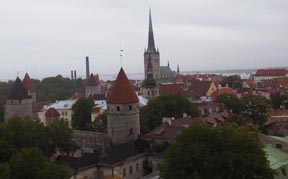
Tallinn is divided into
the Lower Town and the Upper Town. Lower Town buildings
date back to the Middle Ages. A fire destroyed the Upper town in
1684 burning all the wooden structures. Traditionally, the German aristocracy
inhabited the Upper Town and the Lower Town was for the peasants. Some of the
sights in Tallinn include the Town Hall Square with its Harju Gate (one of eight
gates), the Russian Orthodox Church of St. Alexander Nevsky, and Fat Margaret,
which is one of the towers in the old fortress surrounding the city. Because
of the narrow streets, our bus dropped us off at the Upper Town and, after a
short walking tour, we wound down the hill to the Lower Town where we had a
great traditional lunch. Later, the bus took us to an outdoor museum (An early
Estonian version of Williamsburg) where early farm buildings were exhibited.
The people were very friendly and glad to be rid of the Russian domination.
We in turn were not checked for passports. "Come and meet us" appears
to be an Estonian custom.
St.
Petersburg, Russia
We sailed all night and arrived at St. Petersburg by 7 am. The dark clouds
began to clear off and the day was bright and sunny. On the dock was a small
band welcoming the ship, playing all types of music from the Star spangled Banner
to Sousa marches and popular tunes. Someone must have briefed the band on the
nationality apportionment of the passengers. Here in Russia the entry is very
controlled. We had to go through passport control, show our passport, and receive
a "red card" which allowed us to go on the assigned tour bus. This
was our temporary visa. If we lost the red card they could charge us $50. On
this particular Sunday, the city is not busy except for the beer festival in
the center of the town, which we did not see. Driving along the streets, we
saw old drab looking (post WW II) buildings, many of them six story apartments,
cut from the same pattern. All the windows had storm windows with a ten-inch
windowsill separating the inner window from the outer storm window. Only a small
casement window is able to open allowing fresh air to circulate. The streets
are full of potholes and trolley tracks. We were told they are digging up all
the streets at the same time and repairing them in preparation for the 2003
celebration of the founding of St. Petersburg. TV antennas are visible mounted
on either the roofs or on the windowsills. Rare is the satellite antenna, but
those that we could see were the old 36-inch dishes. Old style rusty streetcars
requiring the driver to jump out and manually throw the switch in the roadway
provide much of the public transportation.
St. Petersburg was named
for St. Peter and not, as commonly believed, for the Czar, Peter the Great.
He built the city to protect the shipping and bring Russia into the European
community. The site is located on islands that are connected by nine bridges
with the mainland. The islands are formed by the delta of the Neva River into
the Gulf of Finland. All of the bridges are raised at the same time and remain
raised throughout the night for ship traffic. Gee, that limits movement in and
out of the city! Gee, does anyone want to control the goings and comings of
the population? However, this procedure does allow the shipping traffic to move.
The climate in St. Petersburg is very wet and the city receives only about 20
days of full sun each year. This is a city of over eight million people. The
parks are plain and there are no flowers or organized beauty to the parks, just
simply a place with grass and trees with a bench or two. Progress is measured
by the fact that little grass was there a few years ago.
Our guide talked briefly
of the government and how the people are optimistic about the future. With the
new government, they can believe the leaders. They are hoping for a better life.
Along many of the streets there are no storefronts to beckon you into buy anything
or to advertise the presence of a restaurant. However, I did see an oval sign
over a door advertising an Oriental restaurant. Moscow Avenue is the main street
out of town southward toward the Palace of Pavlovsk. The street is tree lined
with a center right -of-way median for the streetcar. There are kiosks along
the road particularly at the bus stops. There are storefronts and some even
have English advertising. We passed one shopping area where clothes and flowers
can be purchased. Even though there are no flowers planted outdoors, the Russians
apparently buy cut flowers to cheer up the inside of their apartments for there
were many flower stalls. There are many billboards along the roadway. We passed
an Opal plant and a Coca Cola plant. There are extensive greenhouses on the
outskirts of the city where vegetables are grown. Out in the country, there
are some individual houses and vegetable gardens. However, our guide told us
that the gardens risk being pilfered.
The
Hermitage
 Located
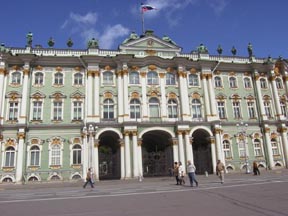
on the bank of the Neva River, the green and white baroque style three-story
palace, the Hermitage or Winter Palace,
is one of the most impressive structures inthe world. The Winter Palace was
the main residence of the Russian Tsars. This museum was formerly the Winter
Palace of Catherine the II of Russia and houses one of the most distinctive
collections of art. To give an idea of the size of the Palace there are some
1786 doors, 1945 windows, and 1057 halls and rooms displaying approximately
2.7 million items. The huge museum complex consists of the Winter Palace, Small
Hermitage, Old Hermitage, and the New Hermitage. If you wish to spend only a
single minute in front of each exhibit, you will be there for 11 years! To see
the Hermitage was our only reason to go to St. Petersburg and, therefore, the
main reason for us to take the Baltic cruise. Our time was artistically used
to view the artwork at the second most popular museum in the entire World which
also happens to be the foremost art museum of the World. Only since the 1980's
has the Air & Space Museum in Washington surpassed the Hermitage in attendance.
We now know why the Hermitage was first for so many years. This is a class act,
despite the hard-faced guards.
Located
on the bank of the Neva River, the green and white baroque style three-story
palace, the Hermitage or Winter Palace,
is one of the most impressive structures inthe world. The Winter Palace was
the main residence of the Russian Tsars. This museum was formerly the Winter
Palace of Catherine the II of Russia and houses one of the most distinctive
collections of art. To give an idea of the size of the Palace there are some
1786 doors, 1945 windows, and 1057 halls and rooms displaying approximately
2.7 million items. The huge museum complex consists of the Winter Palace, Small
Hermitage, Old Hermitage, and the New Hermitage. If you wish to spend only a
single minute in front of each exhibit, you will be there for 11 years! To see
the Hermitage was our only reason to go to St. Petersburg and, therefore, the
main reason for us to take the Baltic cruise. Our time was artistically used
to view the artwork at the second most popular museum in the entire World which
also happens to be the foremost art museum of the World. Only since the 1980's
has the Air & Space Museum in Washington surpassed the Hermitage in attendance.
We now know why the Hermitage was first for so many years. This is a class act,
despite the hard-faced guards.
The original structure
was designed by Francisco Bartolommeo Rastrelli and built in 1754-62. However,
in 1837 the building burst into flames due to overheating in the Palace stoves.
Therefore, the structure had to be rebuilt, which was done under the direction
of Vasily Stasov. Consequently, the building that stands today is not the original
work of Rastrelli, but that of Stasov, who did his best to copy its original
style in every detail. But the Germans destroyed even Stasov's work on the building
during WW II when they surrounded the city for almost two years. The building
complex that we saw is an excellent reproduction, but the artwork within is
ALL ORIGINAL for it had been hidden during the WW II and miraculously survived.
Our first tour was to the
Hermitage, which opened at 9:30 for the cruise ships tours and at 11 for the
general public. Thus, we were able to tour many of the rooms without crunching
crowds. A $3 charge for the camera allowed you to carry and use the camera inside.
As we waited in line to enter the building, there were merchants selling Russian
hats, Soviet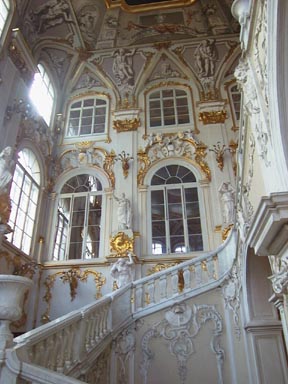 Union
army hats with pins, postcards, and books. Similarly, as we left the Hermitage
and returned to our buses, there were merchants selling lacquered boxes and
other Russian crafts. At the entrance a small band played and as we were approaching
the door they struck up the Star Spangled Banner!! Somebody was doing some Public
Relations. Security is tight in the Hermitage. Overcoats or bulky bags must
be checked. You could carry a light jacket over your arm or strap. The only
restroom facilities are on the entry floor prior to climbing the steps to the
galleries. Be forewarned, because once started on a tour, your guide is like
a colonel leading a charge through deep timber. Ironically to the right of the
entrance is an ATM!
Union
army hats with pins, postcards, and books. Similarly, as we left the Hermitage
and returned to our buses, there were merchants selling lacquered boxes and
other Russian crafts. At the entrance a small band played and as we were approaching
the door they struck up the Star Spangled Banner!! Somebody was doing some Public
Relations. Security is tight in the Hermitage. Overcoats or bulky bags must
be checked. You could carry a light jacket over your arm or strap. The only
restroom facilities are on the entry floor prior to climbing the steps to the
galleries. Be forewarned, because once started on a tour, your guide is like
a colonel leading a charge through deep timber. Ironically to the right of the
entrance is an ATM!
Once inside the entrance
(after you pass the stern looking security guards), the
grandeur of the Grand Staircase becomes really impressive. The
staircase is a recreation of the Jordan style staircase, a ceremonial entrance
on a grand scale. Glittering wall mirrors dominates the staircase surrounded
by golden Rococo designs. After the first flight of stairs of the same creamy
Carrara marble as the handrails, the stairs fork in two broad sweeps to the
right and left. Rising up dramatically above the first floor balustrade is an
elegant colonnade of gray Serdobolye, which makes the ceiling seem higher. On
the ceiling is a scene painted by Italian Gasparo Tiziani depicting the Triumph
of the Gods on Olympus.
The palace is built in
the baroque style with lots of gold overlay, many windows and mirrors. The first
room we entered was the Field Marshall Hall, which was totally destroyed in
the fire including the portraits. A beautiful red carriage made for Catherine
the Great and built in France in the 18th century was on exhibit. If we were
peasants 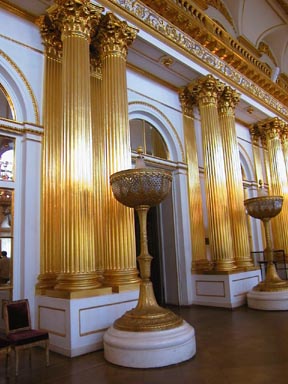 in the
18th century, the grandeur of the carriage alone would have been enough to clamor
for a revolution. The next room was the Memorial Room of Peter the Great (small
Throne Room) designed in 1833. The walls are covered in silk and there are silver
candelabras and the double-headed eagle, the symbol of the Russian state.
in the
18th century, the grandeur of the carriage alone would have been enough to clamor
for a revolution. The next room was the Memorial Room of Peter the Great (small
Throne Room) designed in 1833. The walls are covered in silk and there are silver
candelabras and the double-headed eagle, the symbol of the Russian state.
The next large room was
the Stateroom used as a ballroom. Gold covered
columns, cases of silver items on display, beautiful chandeliers and a large
jasper vase in the center of the room showed the opulence of the palace. The
largest hall is the St. Georges Hall or Great Throne Room, which by using just
two colors, gold and creamy white, create a magnificent room. The floor is inlayed
with 16 different types of wood parquet. Over the throne is a relief of St.
George slaying the dragon. There are a lot of malachite vases throughout the
palace; beautiful dark green with swirling lines enhances their beauty. All
of this art was taken away and hidden during the dark days of WW II.
Possi designed the War
Gallery in 1826 and displays of 332 portraits of officers from the Napoleon
war. There are 13 blank pictures honoring an officer for which they have no
portrait. We then entered the Small Hermitage where we saw a beautiful mosaic
floor that is a copy of a floor in the Vatican made especially for this room.
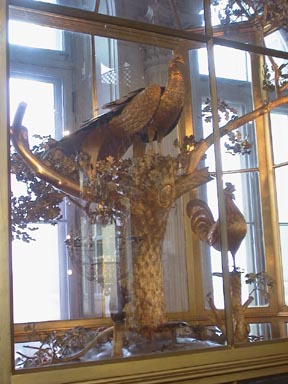
Pavillion Hall is designed
more in the historical style with a view out to the roof garden. Looking at
the roof garden makes you think you are on the main floor and not on the second
floor! A beautiful glass cage with a golden peacock is the central piece in
the room. This is the Peacock Clock, which
is about 6x6x10 feet. When the hour strikes, all of the figures move. When the
clock chimes, the Peacock spreads its plumes and nods, the owl winks and turns
its head, and the cock crows. The time is actually displayed on a small mushroom
on the bottom of the cage. Amazingly, the clock still keeps accurate time!
Country, artist, and chronology
are the arrangement of the paintings in the palace. There are well-dressed lady
guards sitting in each room watching over the visitors. Some of them wear a
green blazer, however, no one appears to have ever asked them to smile. Guarding
may be boring, but, on theother hand, the guards at Windsor Castle were friendly
and even pointed out some of the priceless art.
 The
Hermitage displays some of the great art works of the world. The initial collections
were that of Peter, the Great, who purchased numerous works of art during his
travels throughout Europe. Catherine was the principal collector, but additions
to the collection continued as the court would purchase complete collections.
After the communist revolution, many art works were confiscated from the wealthy
and moved to the Hermitage. All of this priceless art was held in the Hermitage
until the Germans advanced on the city when most was taken and hidden outside
of the city. Only since the post WW II restoration has most of this art been
available to be seen by the public.
The
Hermitage displays some of the great art works of the world. The initial collections
were that of Peter, the Great, who purchased numerous works of art during his
travels throughout Europe. Catherine was the principal collector, but additions
to the collection continued as the court would purchase complete collections.
After the communist revolution, many art works were confiscated from the wealthy
and moved to the Hermitage. All of this priceless art was held in the Hermitage
until the Germans advanced on the city when most was taken and hidden outside
of the city. Only since the post WW II restoration has most of this art been
available to be seen by the public.
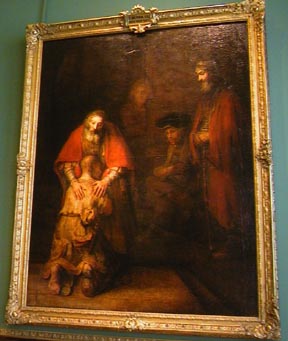
Our initial tour was only
two hours long and we only scratched the surface. We saw the works of Leonardo
da Vinci's Madonna and Child; Titian's Repentant Mary Magalene; Michangelo's
marble statue of Crouching Boy; Raphael's Madonna and Child; Garfalo's Marriage
of Cana; El Greco's series of apostles; Goya's single painting Actress Antonia
Zarato; Rembrandt's Descent form the Cross and Return
of the Prodigal Son. We saw the impressionist artist's works such
as Matisse's the Dance and The Music; Picasso, Marquet, Cezanne, Pissaro, Monet,
and Gauguin. The rooms of the Hermitage, where most of the paintings are displayed,
are simple rather than ornate. Some rooms have domed ceilings with glass skylights
providing lots of natural light for the paintings.
Second Visit to the
Hermitage
Imagine visiting the world's foremost art museum that has thousands of
visitors every day. Imagine the crunch and hubbub of the visitors, as you move
from room to room. Now, imagine that you are all alone in this magnificent museum
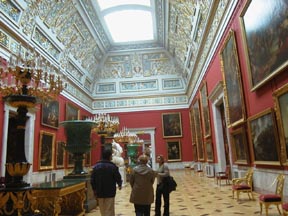 with time
to view the originals of your favorite paintings. Our second visit to the Hermitage
couldn't have been more wonderful. On Mondays, the museums in Russia are closed,
however, for tourist buses from the cruise ships, they are opened by appointment.
Several tour buses had appointments for the afternoon and our group of 24 people
was first! As we entered into the Hermitage, the lights were out, there were
few security people around and as we approached the grand staircase, we were
all alone except for our Russian guide! In each room we entered, we were first
and there were no others on our tail! We could hear our guide giving us the
details on the individual works of art! She had never been in this situation
before. She normally has to talk over the noise of the crowds and tour groups
being led in opposing directions. We could enjoy the fabulous surroundings and
gaze at each of the original paintings. The Hermitage contains only original
art works, not copies. What pictures I missed during our first visit because
there were people in front of them, I could leisurely set them up, take aim,
click, and double check to see that the digital picture was good and if not,
take the picture again! The museum has 26 Rembrandt paintings, 37 works by Matisse,
37 works of Picasso. Our guide, Lena, was excellent and gave us a great tour.
In turn, we were excellent tourists.
with time
to view the originals of your favorite paintings. Our second visit to the Hermitage
couldn't have been more wonderful. On Mondays, the museums in Russia are closed,
however, for tourist buses from the cruise ships, they are opened by appointment.
Several tour buses had appointments for the afternoon and our group of 24 people
was first! As we entered into the Hermitage, the lights were out, there were
few security people around and as we approached the grand staircase, we were
all alone except for our Russian guide! In each room we entered, we were first
and there were no others on our tail! We could hear our guide giving us the
details on the individual works of art! She had never been in this situation
before. She normally has to talk over the noise of the crowds and tour groups
being led in opposing directions. We could enjoy the fabulous surroundings and
gaze at each of the original paintings. The Hermitage contains only original
art works, not copies. What pictures I missed during our first visit because
there were people in front of them, I could leisurely set them up, take aim,
click, and double check to see that the digital picture was good and if not,
take the picture again! The museum has 26 Rembrandt paintings, 37 works by Matisse,
37 works of Picasso. Our guide, Lena, was excellent and gave us a great tour.
In turn, we were excellent tourists.
Pavlovsk
Pavlovsk is the summer palace of Paul I and is about an hour (35 Km) southwest
of St. Petersburg. Catherine gave her son, Paul, this 1500 acre piece of land
when Paul and Maria gave birth to an heir in 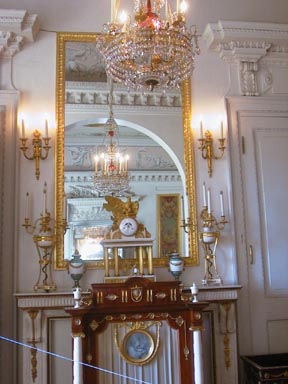 1777.
In 1796, Paul became King but in 1801 he was assassinated. Paul and Maria build
the palace in 1780 and purchased all the artwork. Paul I was very educated and
could read and write in seven languages. Marie was German born and also well
educated; in fact she was a botanist. They had ten children. Maria started the
music tradition at the palace by bringing many musicians to perform. Maria's
diary was very detailed and gave exact accounts of the articles, wall coverings,
furniture, and life in the palace. In 1803, the palace burned, but all of the
art pieces were saved.
1777.
In 1796, Paul became King but in 1801 he was assassinated. Paul and Maria build
the palace in 1780 and purchased all the artwork. Paul I was very educated and
could read and write in seven languages. Marie was German born and also well
educated; in fact she was a botanist. They had ten children. Maria started the
music tradition at the palace by bringing many musicians to perform. Maria's
diary was very detailed and gave exact accounts of the articles, wall coverings,
furniture, and life in the palace. In 1803, the palace burned, but all of the
art pieces were saved.
The palace area has the
largest public park in Europe, over 600 hectares. During WW II, the Germans
devastated all the land on the outskirts surrounding St. Petersburg, including
Pavlovsk, which was burned and pretty well destroyed. However, the Russian's
value their heritage and poured lots of money into the restoration of this palace
and have completely renovated the building down to the gold on the walls,
chandeliers, and silk wall coverings.
Our Pavlovsk tour included
the living quarters, personal study of Paul, family room, sitting room with
its gold leaf table settings, ballroom, state rooms on both the first and second
floor, state bedroom, Greek room with green marble columns, throne room, and
hall of Knights. All through the palace tour were pictures showing the room
before restoration. All of the works of art were saved and have been put back
into the palace. Maria had a lovely little chapel built in the palace where
services are still held. We enjoyed a concert with champagne held in the Ballroom.
The Divertissement String-ensemble played ten pieces: Vivaldi's The Storm; Bach's
Double concert; Mozart's eine Kline Nachtmusik; Tchaikosky's Waltz from Serenade;
Puccini's Crisantemi; Bartok's Romanian dances; Gershwin's Lover man; Lekvona's
La Camparsa; Piazzolla's The Shark; and Boulange's Promenade. Ilia Ioff was
the art director, soloist and conductor of the thirteen violins, three violas,
and one bass group.
In the palace, there is
a montage picture of the Roman Coliseum, the Great Pyramid of Giza and the Parathon,
which was a copy of Raphael's original. What we noticed was the painting was
done in the 1800's and the Great Pyramid was completely covered with the outer
granite covering! This proves that most of the quarrying of the Great Pyramid
was done relatively recently in the Egyptian timescale.
View from the Bus Window
While riding back from the Pavlovsk, I took notice of the environment.
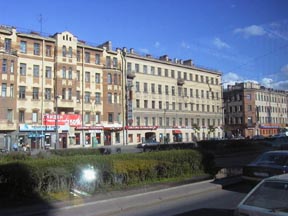
Many apartments have enclosed balconies; construction is of beige brick with
brown trim or gray concrete some with a touch of pink. Some apartment buildings
have very fancy facades, but are in disrepair. The apartments are built from
the same plans either six stories for the inner city buildings or ten to twelve
stories for the outskirts. There are no flowers outside except lilac bushes
that are in bloom. Every once in a while, we saw plants and potted flowers on
the window 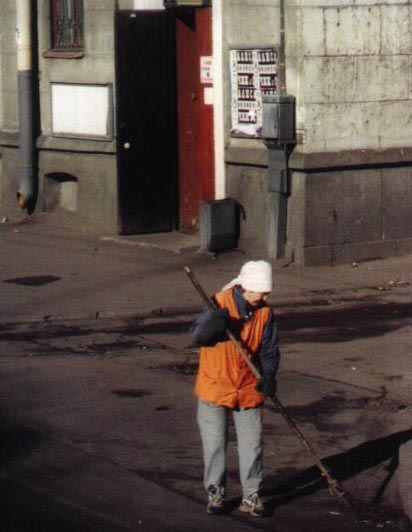 sills
between the storm window and inner window where heating is available. Outside
St. Petersburg a large heating plant produces the centralized city hot water
sills
between the storm window and inner window where heating is available. Outside
St. Petersburg a large heating plant produces the centralized city hot water
 heating
using natural gas. We asked about the large chimney to the north of the city
that looks just like a nuclear power chimney, but we are told, "Nyet!"
Hmmm…strange! The streetcars are very rusty and are probably of 1930's
vintage with the power rack on top of the car contacting the electric wires.
The buses appear old and dilapidated. However, the tourist buses are well maintained
and look quite new. There is an underground subway as the main transportation
system. Cars that we see are Jeep, Escort, Saab, Mitisubsu, and Lada, the Russian
car. At 10:30 pm, there are still many people out and about strolling the streets
and parks. The city is a clean city with no trash on the streets. We saw ladies
with babushka's sweeping the sidewalks and streets in the mornings.
heating
using natural gas. We asked about the large chimney to the north of the city
that looks just like a nuclear power chimney, but we are told, "Nyet!"
Hmmm…strange! The streetcars are very rusty and are probably of 1930's
vintage with the power rack on top of the car contacting the electric wires.
The buses appear old and dilapidated. However, the tourist buses are well maintained
and look quite new. There is an underground subway as the main transportation
system. Cars that we see are Jeep, Escort, Saab, Mitisubsu, and Lada, the Russian
car. At 10:30 pm, there are still many people out and about strolling the streets
and parks. The city is a clean city with no trash on the streets. We saw ladies
with babushka's sweeping the sidewalks and streets in the mornings.
Forecasting the weather
in this area must be difficult or they need better equipment. The same day there
were two forecasts, one saying rain and the other saying sunshine. Well, we
had rain during the night and the day was beautiful blue sky and warm! What
can you say…? We got what we wanted.
Peterhof
Peterhof is 32 miles outside of St. Petersburg to the southwest on the
coast of the Gulf of Finland. Peter, the Great, built his summer palace to resemble
Versailles. Peter brought European traditions to Russia. During WW II all the
surrounding areas were captured and destroyed by the Germans including Peterhof.
The palace was plundered and burned as the Germans retreated. Madness!! Fortunately,
all the paintings and samples of furniture, wall coverings, and other things
necessary to reconstruct the palace were saved. Over a 30-year period, many
archivists spent their career bring back the opulence of Peterhof. We used slippers
to cover our shoes while walking through the palace. The three-headed eagle
sets on top of the pavilion building. As we approached the front door of the
palace, there was a band playing and all donations went to the reconstruction
of the palace. As we got closer, they played British and American songs including
the Star Spangled Banner and God Save the Queen! Great PR!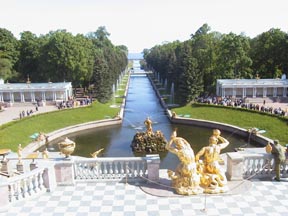
At first the palace was
smaller, but Peter's daughter Elizabeth enlarged the facility. She loved luxury
and, when the palace was finished, the national treasury was broke. We toured
through the beautiful rooms with gold gilding, bronze chandeliers, mirrors,
reliefs on the walls and ceilings, and beautiful original paintings. Elizabeth
ruled for a number of years, but then chose her sister's son, Peter III, to
rule. Peter was weird and not good for the country. Elizabeth chose atherine
from Germany for Peter's wife. Catherine, subsequently, assassinated Peter and
became the ruler of all of the Russians for 34 years. She died at 67.
The estate has seven parks
and more than twenty smaller palaces and pavilions. The gardens were beautiful
and, like Versailles, had many fountains. From the
back of the palace to the Gulf of Finland there is a canal lined with fountains.
The fountains are all gravity fed from springs, which then dump into the Gulf.
The main fountain, Samson, is one of the biggest in the world and shoots water
62 feet in the air. The fountain was built in 1734 to commemorate the 25th anniversary
of the victory of Russia in the Northern War against Sweden. While we were there,
the fountains sprang to life in tune with the local band in costume livery.
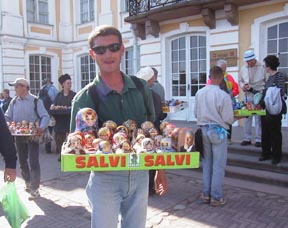 Around
the palace are vendors selling lacquer boxes, scarves,
army hats/pins and the well-known matryoshka or nesting dolls. The
nesting folk boxes were first invented in China about 1000 AD. The Chinese doll
boxes were poorly made but the Russian's improved on the design. The master
carver Zveydochin turned the dolls on a wooden lathe while the artist Malyutin
painted the first set. The nesting dolls split in half to reveal another, smaller
doll, and another. Most sets have five dolls with some larger sets having eight
to ten dolls.
Around
the palace are vendors selling lacquer boxes, scarves,
army hats/pins and the well-known matryoshka or nesting dolls. The
nesting folk boxes were first invented in China about 1000 AD. The Chinese doll
boxes were poorly made but the Russian's improved on the design. The master
carver Zveydochin turned the dolls on a wooden lathe while the artist Malyutin
painted the first set. The nesting dolls split in half to reveal another, smaller
doll, and another. Most sets have five dolls with some larger sets having eight
to ten dolls.
Manufacturing the lacquer
box from papier-mâché is a long process. The cardboard is sliced
into various sizes, pressed, and glued. While still wet with glue, the sheets
are wrapped on various molds, i.e. rectangular, square, round or cylindrical
shape. Once dry, the material is placed in a hot linseed oil bath for about
30 minutes then dried in an oven over a 30 day period where the temperature
is gradually increased to 100 degrees centigrade then decreased back to room
temperature. When dried, the mold is removed, hinges are affixed, and carving
and sanding are done. Three coats of black paste are applied which are dried.
Finally the piece is cleaned and polished. Three coats of black lacquer are
applied and dried after each coat. The inside is covered with two or three coats
of red lacquer and dried. Next, the box is covered with clear lacquer inside
and out and dried. Finally the box is given to the artist who outlines the design.
A zinc or titanium coating and the colors are applied with extremely fine brushes.
Gold leaf is carefully crushed and ground by hand and applied. The school name
and title of the artist is placed on the bottom of only the quality pieces.
The vendors are very nice
young men who do not hassle you to buy, but instead are pleasant salesmen. They
all know English. Several couples were dressed in period costumes and were charging
a fee to have your picture taken with them. We left the Palace via a Russian
hydrofoil back to the center of St. Petersburg near the Hermitage.
Lunch was in one of the
prestigious hotels of St. Petersburg, the Astoria, located behind St. Isaac's
cathedral. The Astoria is over a hundred years old. Hitler planned to have his
victory party at the hotel and had already printed the invitations! So much
for planning his future… For lunch we had a greens salad, champagne, Stolinyga
vodka, a light borsch (beet juice, beet pieces, onions, bacon, and carrots),
chicken Kiev, rice with corn, and ice cream for dessert. A three-piece group
and a singer provided wonderful classical music during our meal.
Yusupov
The last palace we visited was Yusupov, which belonged to the niece of
Peter, the Great. This is where Felix, the son of Yusupov's youngest daughter,
assassinated Rasputin. In 1902, Rasputin, a monk from Siberia, came to St.,
Petersburg and in 1904 he was introduced to the royal Romanov family. Rasputin's
reputation of healing and being a holy person influenced the Empress Alexandra
and her husband, Tzar Nicholas, to have him cure their son, Alexis, of hemophilia.
Rasputin, apparently, had considerable power over Alexandra and a group of Russians
decided to kill him. Prince Felix Yusupov invited him to dinner where Rasputin
consumed cakes and wine laced with cyanide. The poison failed to act, so Felix
shot him. Rasputin came back to life, escaped, and was eventually shot by the
palace guards. His body was dumped into the Neva River. When his body was recovered
from the river, his lungs were full of water indicating that he was still alive
and died by drowning! The original tough guy!
The Yusupov's were great
friends of the Romanovs and purchased the palace. The Yusupov's were one of
the richest and most influential families in Russia. The palace dates to the
1740's and is in the baroque style. Nikolai Yusupov was an art connoisseur and
acquired art for the Hermitage and also his private collection that was the
best in the country. After 1917, everything was confiscated, taken to Moscow
and sold, thus many art works were lost. Money was no object for decorating
the palace. Gold and crystal chandeliers, Flemish tapestries, and beautiful
silk wall coverings.
The last room that we visited
was the family's theater where concerts were held. With seating for 100 guests,
the theater was completed in the late 1860's. The artist who designed the theater
introduced balconies and boxes, rich with beautiful moldings. We enjoyed the
St Petersburg Soloists concert consisting of thirteen violins, two violas, and
one bass. We heard Mozart's Divertissement; Vivaldi's Concerto #6; Rossini's
Sonata #1 for Strings; Mozart's Adagio; and Tchaikovsky's Waltz. Well done!
More on Russian Life
The Russian life, that we observed, is still difficult, but getting better.
There are private companies and more businesses offering opportunities for employment.
Our guide told us about the use of passports. Every Russian may have two passports,
one is for international travel and one for internal. The internal passport
says what city, street, and house you live in and this is your "assignment".
You can't change assignments, that is, move to another city or location, unless
you buy an apartment, marry, or trade with someone. This prevents people from
moving from city to city. No one can hire you without the correct local assignment.
As we left St. Petersburg,
the ship followed a narrow channel toward the Gulf of Finland. We passed very
close to the Russian military base of Kronstadt, which is in very sad condition.
There were three submarines next to a pier and several other small naval ships.
Derelict ships are sticking out of the water or beached. At one time this was
the main Soviet Naval Base to the Baltic. A construction project covering a
large area looked like the effort was cancelled just after the major ground
substructure was completed. The workers seemed to just have walked away a few
years ago. Upon return home a former NAVAIR member of John's Romeo group informed
us that he was in St. Petersburg two weeks after we were and he was told the
construction site was for a harbor tunnel that was cancelled because of lack
of funds several years ago.
Helsinki
We arrived in Helsinki with overcast skies and rain. We were on our own
from 8 am till 4 pm to discover this lovely city, the capital of Finland. A
tourist information bus was parked right beside the gangway of the boat and
we were able to find out about the public transportation. We caught the #2 tram
and left the wharf area headed about ten blocks into town where we transferred
to a #3T tram that circles the major part of the city and provides a city tour.
The map we had gave us the names of the places we were passing. Today is a special
holiday for Helsinki; the city's 450th birthday. Thus, the people were bustling
in the town with special events in the park.
Helsinki is quite different
from St. Petersburg with lots of trams, buses, flowers in pots on the sidewalks,
flowering chestnut trees, lilac bushes, and pansies. People are out and about.
The parks are all trimmed and have kids play equipment and flowers. This is
very different from the drab Russian environment.
We walked through the city
market, an old brick building down on the docks. Beautiful salmon filets, bacon,
beef, chicken, lovely fresh veggies such as cauliflower, cucumbers, tomatoes,
garlic, candies (shapes of turtles, nuts/bolts, dogs, etc), sandwiches, and
many other food items. Well displayed produce, meats, fish and trinkets. The
city market also had clean bathrooms. The outdoor market has more fresh veggies,
fruits, and crafts.
We decided to take the
local ferry (15 minutes) to the Sea Fortress of Helsinki, named Suomenlinna,
where we learned about the history of Helsinki at the excellent Visitor's Center.
Finland has quite a convoluted history of being part of Sweden, part of Russia,
and finally independent. Finland shares 700 years of history (1155-1809) with
Sweden as a partner with elected representatives to the Swedish parliament.
The Vikings populated the coastal areas and the Finns the interior. About 1650,
the Swedish King Gustav built Helsinki in an attempt to take over the Russian
trade. In 1703, Peter the Great had built St. Petersburg and Kronstadt, an island
fortress protecting St. Petersburg. Thus, Sweden decided to build a fortress
as a buffer between themselves in the small town of Helsinki and Russia starting
in 1747. France, who was allied at this time against Russia, contributed 90
barrels of gold during the first 18 years of the construction. The fortress
was named Sveaborg. In 1788, Russia was involved in the Crimea War and Sweden
declared war on Russia with the result that the Russian losses were high, but
no territory was lost or exchanged. Sveaborg by then was thought to be the biggest
fortress in the world and was called the Gibraltar of the North. A few years
later, Russia starts a war with Sweden and in 1808 attacks Finland and occupies
southern Finland. Sveaborg had many more military men than the attacking Russians,
but in just five days of fighting, the Swedish commandant started negotiating
with the Russians and within the month he surrendered the fortress much to the
chagrin of his men. In 1917, Russia still controlled Finland and Sveaborg, but
in 1918 in the war with France, Germany supported Finland and the Russians left
and finally Finland controlled Sveaborg and renamed the fortress Suomenlinna.
During this entire period, the town of Helsinki on the mainland became the city
of Helsinki and eventually the Capitol of Finland. The island with the fortress
is now a World Heritage Site. An adjoining island houses the Finnish Naval Academy.
After buying some ice cream
with the last of our money, we took the little ferry back to Helsinki. The ferry
can carry two vehicles sidewise and about 25 passengers. We walked through the
business district, including a pedestrian only plaza, and eventually took a
#2 tram back to the boat using tickets we had bought earlier that morning. Great
way to get an introduction to a must return, vibrant city and an interesting
country.
Stockholm
Sailing into Stockholm through an archipelago of about 25,000 islands takes
about two to three hours. We were up at 6 am to appreciate the view of the islands
as we threaded our way toward the city. Many islands were populated with homes
and boats, of course. Lovely blue-sky day, what more could we ask for. At the
dock there is a topless sight seeing bus that stops at fifteen locations allowing
you to hop on and off all day long for $15 per person. Great deal! Rush hour
traffic is heavy, taking us an hour to do the first half of the sightseeing
tour before arriving at the Vasa Museum.
Another history lesson…
Sweden was at war with Poland and the Polish King insisted he was also the King
of Sweden. War took place in Poland and Sweden needed ships with two gun decks.
The Vasa was designed, with a lot of guidance from the King, and built as one
of the first to be fitted with two gun decks. On August 10, 1628 a crew of 150
men plus families of some of the crew were on board along with provisions for
450 soldiers. The soldiers would be picked up as they sailed out the archipelago.
The Vasa slid into the water, a gust of wind tilts her, she righted. Another
gust of wind and she righted again.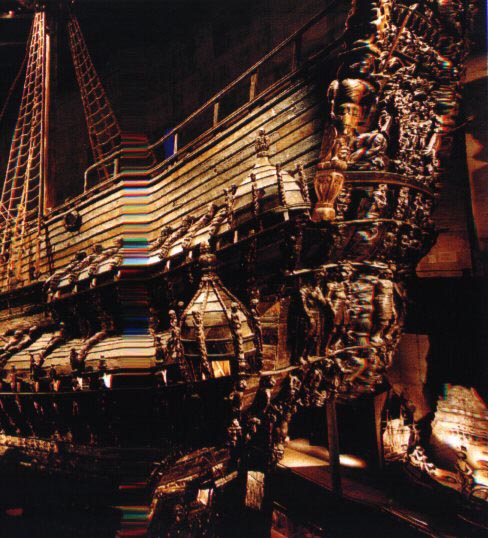 A third gust of wind and water gushes into the open gun ports and she capsizes
within one kilometer of her launch site! Twenty-five to fifty people die on
board the ship. The problem was that there wasn't enough ballast to balance
the 64 guns and the top-heavy guilded construction and numerous sculptures and
superfluous and whimsical carvings. The metacentric height (the difference between
the center of mass and the center of gravity) was too high. The value of this
ship now is the fact that there are no drawings or ship building calculations
for these early ships and this one was fully loaded with the equipment of the
time period. The Vasa is a cultural and physical time
capsule! The ship was raised in 1961 and reconstructed. Spraying
the ship with polyethylene glycol for seventeen years has prevented the wood
from drying out and deteriorating. There are over 500 sculptures all over this
ship. The museum has a movie and guided tour in addition to the many displays.
The Vasa requires at least four hours to really "see" and that is
what we had allocated. This is a MUST do for any visitors and a return visit
is needed for our next visit to Stockholm. Vasa is a Man-of War and not a small
ship.
A third gust of wind and water gushes into the open gun ports and she capsizes
within one kilometer of her launch site! Twenty-five to fifty people die on
board the ship. The problem was that there wasn't enough ballast to balance
the 64 guns and the top-heavy guilded construction and numerous sculptures and
superfluous and whimsical carvings. The metacentric height (the difference between
the center of mass and the center of gravity) was too high. The value of this
ship now is the fact that there are no drawings or ship building calculations
for these early ships and this one was fully loaded with the equipment of the
time period. The Vasa is a cultural and physical time
capsule! The ship was raised in 1961 and reconstructed. Spraying
the ship with polyethylene glycol for seventeen years has prevented the wood
from drying out and deteriorating. There are over 500 sculptures all over this
ship. The museum has a movie and guided tour in addition to the many displays.
The Vasa requires at least four hours to really "see" and that is
what we had allocated. This is a MUST do for any visitors and a return visit
is needed for our next visit to Stockholm. Vasa is a Man-of War and not a small
ship.
Stockholm is a beautiful
old city, founded in the 13th century, with many walking streets, both in the
old town and the new town. The palace is in the old town with the changing of
the guard every day at 11:15 am. This is the city where the Nobel Prizes are
awarded from the City Hall that sets on the edge of the lake, which spills into
the harbor. There are many squares in town some with fountains, some with trees,
some with benches. The buildings are colorful and have lovely reliefs and facades.
Ship Board Life
The Norwegian Dream took care of our every need and then some. There are
twelve decks with eight places to eat - Trattoria, Sports Bar, Four Seasons,
Terraces, Pizzeria, Poolside weather permitting for a BBQ, Le Bistro, and sometimes
food in the Observatory room. Dining is free style whereby you can eat at anytime
and in any restaurant and with anyone. Food is good and varied. On the ship
you can have as much as you want! 'Tis dangerous, for you to put on weight,
especially when you can eat almost 24 hours a day! Midnight buffets each night
with a chocoholic buffet on the last night. There are stage shows every night
in the Stardust Lounge, plus music in various other lounges, and a small casino,
which operates when we are not in port. The Dream has a six person Russian band
from St. Petersburg, that now call Miami home. They plays for all the shows
and also do special musical treats. There are two pools and two hot tubs. There
are about 745 crewmembers and some of the countries represented are Romania,
India, Philippines, Jamaica, Germany, Norway, and England. Since the cruise
line has a main office in Miami, many of the crew now reside in Florida.
Some statistics about the
ship… Serves up to 9,000 meals daily, 152 people work in the galley, they
order 18,000 lbs of beef, 9,000 lbs of poultry, 3,500 lbs of veal, 5,000 lbs
of seafood, 19,000 lbs of fresh vegetables, 18,000 lbs of fresh fruits, 9,000
lbs of potatoes, 20,000 lbs of flour, 1,600 lbs coffee, 10,500 gal of milk,
and 9,000 dozen eggs. They bake all their own bread 24 hours a day; they use
over 370 lbs of chocolate; and serve up to 80 gallons of coffee at one time.
Copenhagen
 Our last stop
was in Copenhagen for a brief overnight. We docked at dinnertime and many of
the passengers are going to Tivoli. There are shops right where we dock and
also topless tour buses like those in Stockholm selling $15 tickets good for
two days but we didn't know that before buying our ticket to the Tivoli bus
from the ship. Tivoli now is primarily restaurants and rides; more restaurants
and less rides than 20 years ago; different but not as elegant as our memories.
We strolled around the gardens, saw the pantomime show and listened to two groups
play music. Copenhagen and Stockholm have a rental bike facility at many places
around the city. In Copenhagen, you just pay 20 KR (about $3) and take any bike,
then when you return the bike to any of the rental places in town or the local
suburbs; you will get your money back. The bikes are just basic bikes, but certainly
well used by the people. There are bike lanes and all of the bikers obey the
traffic lights unlike at home where the bicyclists usually go through the lights.
On Friday morning, we walked into town for a five mile round trip. We strolled
down Stroget Street, the walking street, however the street has changed considerably
over the years since we bought our every day silverware. The street no longer
has elegant china, jewelry, and silverware shops, but just clothing and shoe
shops. Bummer!
Our last stop
was in Copenhagen for a brief overnight. We docked at dinnertime and many of
the passengers are going to Tivoli. There are shops right where we dock and
also topless tour buses like those in Stockholm selling $15 tickets good for
two days but we didn't know that before buying our ticket to the Tivoli bus
from the ship. Tivoli now is primarily restaurants and rides; more restaurants
and less rides than 20 years ago; different but not as elegant as our memories.
We strolled around the gardens, saw the pantomime show and listened to two groups
play music. Copenhagen and Stockholm have a rental bike facility at many places
around the city. In Copenhagen, you just pay 20 KR (about $3) and take any bike,
then when you return the bike to any of the rental places in town or the local
suburbs; you will get your money back. The bikes are just basic bikes, but certainly
well used by the people. There are bike lanes and all of the bikers obey the
traffic lights unlike at home where the bicyclists usually go through the lights.
On Friday morning, we walked into town for a five mile round trip. We strolled
down Stroget Street, the walking street, however the street has changed considerably
over the years since we bought our every day silverware. The street no longer
has elegant china, jewelry, and silverware shops, but just clothing and shoe
shops. Bummer!
Our weather is beautiful
and warm, just a need for a jacket. We set sail at noon for a day and a half
up through the North Sea where the seas were calm. We reached Dover at 5 AM
Sunday morning, cleared customs and were transported to Heathrow Airport. Unlike
most of the group, we did not fly home. We picked up a brand new rental car
and were on our own for two weeks in Southern England and Wales.
Postscript
Timing is everything! The Dream left Dover the evening we disembarked with
a new group of passengers. She got out about four hours, had engine trouble,
and had to return to Dover for two days of repairs. An associate of John's was
on another cruise ship that met up with the Dream in St. Petersburg. The Dream
passengers were ANGRY. The ship had bypassed the port for the Berlin excursion
and bypassed Tallinn and the passengers, reportedly, were not being compensated
for the shortened cruise. Major bummer!!
Carolyn
& John McHale
Date: 7/12/2001